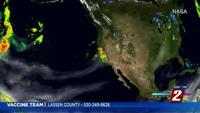

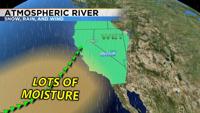
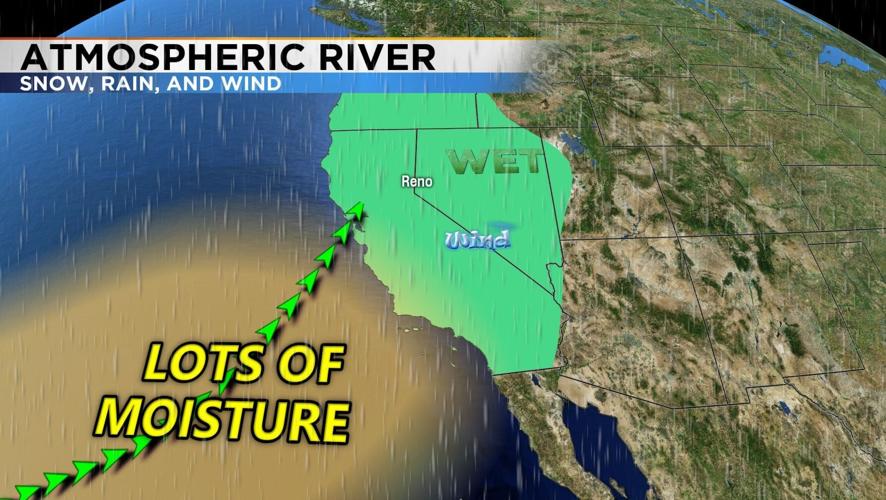
Atmospheric Rivers play a big role in our water supply. Not only can they cause our rivers to flood, but the lack there of can also trigger a drought. Our drought situation in the Sierra has improved slightly, going from a severe drought in December to now being in a moderate drought. The valley is still on the edge between a severe drought and extreme. Our snow pack and water supply would be much lower if it was not for the atmospheric river that moved through California around January 29th, 2021. This particular storm also had plenty of cold air, bringing over a foot of snow to parts of the valley. The Sierra got several feet of snow by the time the storm was gone. This is a great example of how an atmospheric river can boost our water supply. All it takes is one storm to turn things around. An atmospheric river is a river of moisture coming up from the Hawaiian Islands. According to NOAA, most of them range in size from 250 to 375 miles wide. According to NASA, most of the storms that fall along the west coast are not atmospheric rivers, but the ones that do usually accounts for about 40 percent of the Sierra’s snowpack.

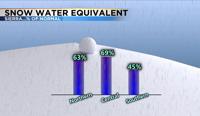
We could use some more snow though. Most of our individual basins are about 60 to 70 percent of normal. As of March 1st, the northern Sierra is at 63%, the central Sierra is at 69 percent, and the southern sierra is at 45 percent. We would be in far worse shape without that one atmospheric river event from a little over a month ago. According to NOAA, the amount of water vapor a strong atmospheric river carries is similar to 7.5 to 15 times the average water flow of the mouth of the Mississippi River. This is one reason why they can do a lot of damage, especially if they are on the warm side, producing a lot of wind. That can lead to flooding and a shrinking snow pack. A handful of weak to moderate atmospheric rivers with some cold air, is ideal. Just like the one in January. 2016/2017 was a great snow season filled with numerous atmospheric rivers, some of them on the stronger side. The stronger the atmospheric river, the more damage they can do because of flooding and wind. The temperature of the AR is key too. Warm rain over snow can cause a lot of flooding. What helped us out in January is that some cold air had already moved in, so we got snow instead of rain in the Sierra. Parts of the valley mainly got rain though. The hills were buried in snow.

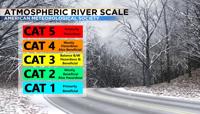
Climate data shows the likelihood of an atmospheric river in March is much lower, but not unheard of. Models are showing the possibility of more snow in March, but no atmospheric rivers or huge storms in the near future.