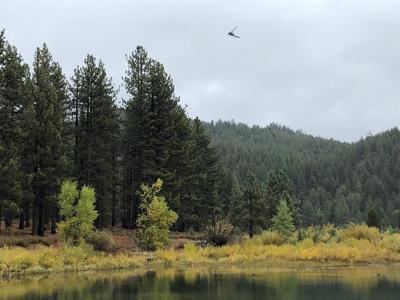
The Nevada Division of Forestry is working with several other state agencies to thin 300 acres of forest around Spooner Lake. It is using a helicopter to remove the trees.
"Because of the lack of access and the concern for watershed and archaeological resources, we're having to use a vertical lift system which is a helicopter," Roland Shaw, Forester III with NDF said.
Shaw says most of the trees are healthy but many still have to be removed because it is affecting the overall health of the forest.
"They're competing for water and nutrients and if we want these trees to get bigger, we're going to have to give them some space and some water," Shaw said.
Shaw says a thinner forest is better for the habitat of wildlife and it allows the remaining trees to thrive. They have a better chance to withstand drought and wildland fires. The average diameter of each tree is about 20 inches.
"These are not small trees," Shaw said. "This forest has basically come back since the Comstock era without much in the way of natural fire or any kind of management."
It also helps them defend the trees against bark beetles, because of a higher amount of tree sap.
"If they're competing and they don't get enough, they can't really make the copious amounts of pitch that they need to pitch out bark beetles," Shaw said.
On a good day, the helicopter can remove 250-300 trees, attaching them to a 250-foot tag line. Each load can weight 2,800-3,400 pounds.
"We marked 5,737 trees, so it's going to take them awhile to move those sticks off the hill," Shaw said.
Crews are removing trees in areas where they want more aspens to grow, rather than the more fire-prone conifers.
During the project, parts of the Tahoe Rim Trail and Spooner Lake Trail are closed because debris can fall from the trees as they are transported.
"They have options to get where they need to go but we just can't have people out there when they're flying trees," Shaw said. "We'll get this area on the east side of the lake by the Rim Trail done as quick as we can so we can get those trails open and get people back hiking out there."
Once the helicopter drops the trees off, the branches are removed and the logs are trucked to a lumber mill in Quincy. The wood chips are sent to Portola.
The project started September 12 and is expected to be finished by November 16, depending on weather and equipment.