


UPDATE: JUNE 23, 2021
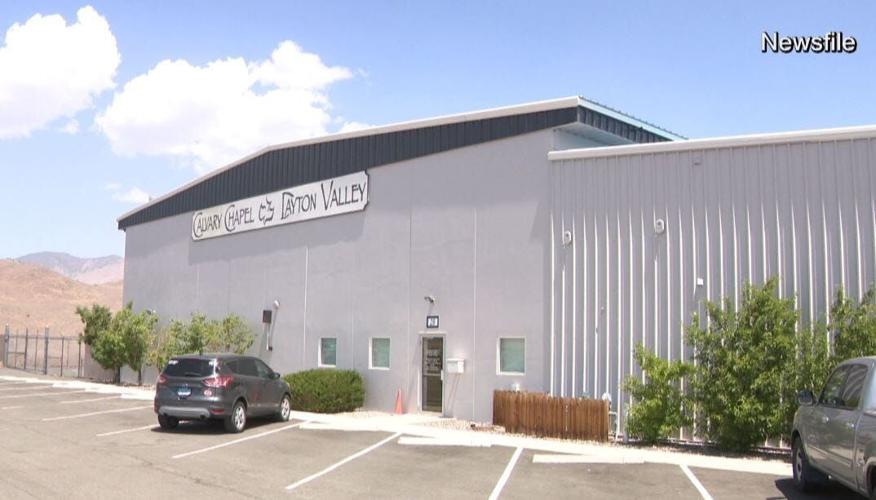
The state has agreed to pay $175,000 in legal fees to settle a lawsuit with a rural Nevada church over COVID-19 capacity caps on religious gatherings that a U.S. appeals court found illegal in December.
But a second church in Las Vegas is continuing to press for a court order declaring Gov. Steve Sisolak’s earlier limits unconstitutional.
No COVID-19 restrictions have been in place since June 1.
The Board of Examiners approved the $175,000 payment to Calvary Chapel Dayton Valley east of Reno earlier this month.
Lawyers for Calvary Chapel Lone Mountain in Las Vegas filed a motion June 11 seeking permission to amend its ongoing complaint.
(Copyright 2021 The Associated Press. All rights reserved. This material may not be published, broadcast, rewritten or redistributed without permission.)
UPDATE: June 10, 2021
A United States District Judge says the Calvary Chapel Dayton Valley and state of Nevada have settled over the government's authority to limit the size of religious gatherings.
In a court document filed May 13th, both parties agreed to settle the matter "without further contested litigation" for $175,000.
The case reached the Supreme Court - twice - before being refused a second time, which you can read further below.
When the Supreme Court refused the church's request for a hearing in January, Sisolak's order limited places of worship to 50 people regardless of fire code capacities, but allowed casinos, restaurants and more to limit to 50% capacity.
In a statement, David Cortman, the senior counsel and VP of U.S. Litigation for Alliance Defending Freedom says: "The governor failed to offer any evidence that places of religious worship are a greater threat to COVID-19 transmission than other secular activities. The 9th Circuit made clear in its decision that Calvary Chapel Dayton Valley can’t be treated more harshly than Nevada’s casinos, bowling alleys, retail businesses, restaurants, and arcades."
The settlement says Nevada agrees to the church "reasonable attorney's fees and taxable and non-taxable costs for the work performed and costs incurred in the court and the Ninth Circuit."
It goes on to say that costs shall be paid by the end of business on July 7th.
UPDATE: January 25, 2021
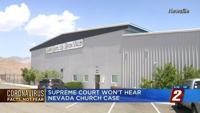
The U.S. Supreme Court has refused a rural Nevada church’s request to weigh in on a legal battle over the government’s authority to limit the size of religious gatherings.
The high court on Monday denied Calvary Chapel Dayton Valley's petition seeking to review the case on its merits.
Attorneys general from 19 other states had recently joined in support of the church east of Reno.
They were urging the Supreme Court to rule on the Nevada case to help bring uniformity to various standards courts across the country have used to balance the interests of public safety and freedom of religion.


UPDATE: January 11, 2021
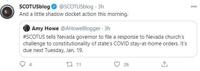
The Supreme Court has told Nevada Governor Steve Sisolak to file a response to a Dayton church's challenge to constitutionality of the state's stay-at-home orders. The court says the response is due next Tuesday, January 19th.
Last month, the 9th Circuit Court of Appeals reversed its ruling on church attendance in Nevada, citing the Supreme Court in New York as a reason for reversal.

That SCOTUS decision ruled that Governor Andrew Cuomo's executive order discriminated against places of worship by placing hard attendance caps on the services.
The 9th Circuit panel compared Governor Sisolak's executive order to Cuomo's and decided the hard caps treated "numerous secular activities and entities significantly better than religious worship services."
The panel concluded its ruling by returning the case to lower courts for further proceedings.
Sisolak's order limited places of worship to 50 people regardless of fire code capacities, but allowed casinos, restaurants and more to limit to 50% capacity. The Governor's newest directive limited capacity to 25%.
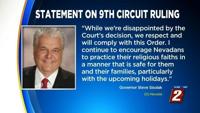
At that time, Sisolak released a statement on the ruling, asking leaders of faith to remain role models for the community. "There is no doubt that your faithful followers will continue looking to you as role models during these challenging times. As respected and trusted leaders in our communities, I ask that you continue to do all you can to protect your worshippers and the faithful, especially when COVID-19 infection rates, hospitalizations, and deaths are at an all-time high in Nevada," he said.
The Governor also reminded places of worship that they must comply with the other rules under the directive.
undefined
The updated directive for places of worship can be found below.
UPDATE: December 9, 2020
A three-member U.S. appeals court panel appears sympathetic to arguments by lawyers for two Nevada churches that say state COVID-19 restrictions treating churches differently than casinos and other secular businesses violate their First Amendment rights.
The 9th Circuit panel in San Francisco heard arguments Tuesday from lawyers for the churches that want the appellate court to reverse earlier district court rulings upholding hard attendance caps Nevada's governor has set on the size of indoor worship services.
They say churches should be held to the same standards that allow casinos, bars, restaurants and others to operate based on a percentage of their capacity, not a hard cap. (AP)
UPDATE: November 5, 2020
A rural Nevada church has again filed a petition with the Supreme Court to declare the state's 250-person cap on religious gatherings unconstitutional during the pandemic.
To support its case, the Calvary Chapel Dayton Valley shows several photos of casino gatherings - after the gaming establishments were allowed to reopen on June 4th.
The first time around, lawyers argued the hard cap on religious gatherings while allowing casinos to operate at 50% capacity put profits ahead of the First Amendment.
The current cap on religious gatherings is 50 worshippers.
"Although the governor’s newest order increased the cap, it continues the unequal treatment by allowing casinos and other secular establishments to operate at 50% capacity with no cap," writes Alliance Defending Freedom.
A procedural rule allows Calvary Chapel Dayton Valley to ask the high court to weigh in even while its lawsuit moves forward at the U.S. Court of Appeals for the 9th Circuit.
UPDATE: September 3, 2020:
A rural Nevada church is trying again to persuade the 9th U.S. Circuit of Appeals that the state’s 50-person cap on religious gatherings is unconstitutional.
Lawyers for Calvary Chapel Dayton Valley filed new briefs with the San Francisco-based appellate court Wednesday after the Supreme Court narrowly refused in July to grant an emergency order suspending the COVID-19 policy.
They’re emphasizing the three dissenting opinions from the high court’s 5-4 decision in their bid to prove parishioners’ religious freedoms are being violated.
They argue the hard cap on religious gatherings while allowing casinos to operate at 50% capacity puts profits ahead of the First Amendment.
UPDATE, July 24 2020:
The Supreme Court on Friday rejected the request from Calvary Chapel Dayton Valley to block enforcement of state restrictions on attendance at religious services.
The vote was 5 to 4.
Calvary Chapel Dayton Valley argued the state treated houses of worship less favorably than casinos, restaurants and amusement parks. Those businesses are limited to 50 percent of their fire-code capacities, while religious services have a 50-person limit.
Attorneys representing Calvary Chapel Dayton Valley have filed an emergency application to the U.S. Supreme Court.
The group is asking the high court to immediately stop Governor Sisolak's 50 person cap on religious services.
Attorneys filed the application after the 9th Circuit Court of Appeals in San Francisco refused to do so.
As we've reported, the church says the hard cap violates its religious freedoms and treats churches differently than many businesses that have been allowed to reopen at 50% capacity.
We spoke to those attorneys to find out why they're taking this lawsuit all the way to the highest court.
"There’s nowhere else where thousands and hundreds of people can gather in close proximity for extended periods of time like in a casino, in bars, in amusement parks, water parks. All these places that are being treated better than place of worship,” says Jeremiah Galus, Alliance Defending Freedom.
Lawyers for the state argue that the cap does not violate churches First Amendment rights.