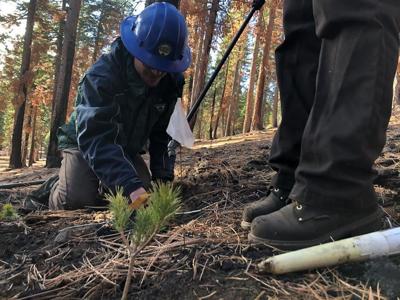
UC Davis is partnering with the California Conservation Corps to plant 5,000 sugar pine seedlings on the north and west sides of Lake Tahoe. They took the seeds from pine cones in 2017, and they have been raising the seedlings ever since then. Today, the seedlings are only a few inches tall and ready to go into the ground.
"When you see them right now, they're really small but in 25 years, they'll hopefully get really big," Nohema Gacia, California Conservation Corps said.
"We are planting a lot of trees," Tami Skaggs, Supervisor for California Conservation Corps said. "This is the second time we've done this. We did it a couple of weeks ago in some other parts of Lake Tahoe."
About 15 members of the CCC are helping forest biologists from UC Davis plant the trees. Experts say they will help with long-term carbon storage, soil stability, water quality in the lake, and biodiversity. Logging during the Comstock Era removed all but about five percent of Lake Tahoe's sugar pines. It is estimated that 129 million trees died in the Sierra Nevada from drought or bark beetle infestation between 2012 and 2016. About 72,000 of them were in Lake Tahoe.
"We do our best and we're hoping whatever we restore will be enough," Camille Jensen, Forest Biologist for UC Davis said. "Hopefully, they'll establish a population. If we have 50 trees that grow in this area, there will then be a decent-sized population."
Researchers took the seeds from trees that survived the drought in areas where most of the other sugar pines died. They are hoping the seedlings will have the same resilience as the parent tree.
"That tree was a survivor so we selected that tree to collect seeds from so that we could use it into the future," Jensen said.
Jensen and her team carefully selected locations to plant the new trees. They plant three trees in a triangular pattern within a few feet of each other with the idea that one of the three will survive.
"We wanted partial shade but we wanted good soil," Jensen said. "We have them recorded and we're going to track to see which sites do well and which tree mother species have higher amounts of survival."
They spent Monday planting a few hundred trees at Sugar Pine Point State Park on the west side of Lake Tahoe. That area is clear of underbrush after getting treated with a controlled burn, earlier this year.
"Part of the point of this work is just to get an idea of what the best way to plant is and the best way we can get the largest amount of survival," Jensen said.
Each seedling is recorded, so researchers can use GPS to locate the trees as they mature.
"We have it all mapped out because we want to be able to visit them for the next three to four years because we believe in three to four years, we'll know if they've established and they're going to survive," Jensen said. "We want to know how to get good tree survival so that into the future when we need to re-establish a population and they do restore forests, we're doing it the right way and we're doing it the most efficient way."
Jensen says some seedlings do better when they are planted in the fall and others do better when they're planted in the spring. The November seedlings are getting planted ahead of the wet season. Jensen says the growing season is typically in the late spring.