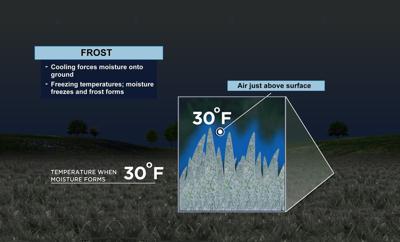



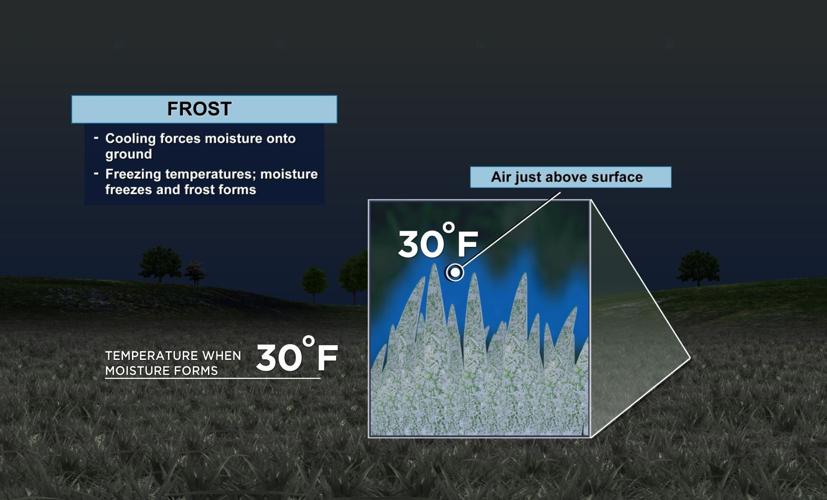
It’s that time of year when frost can form. If it is thick enough it can even look like snow. Frost is a collection of tiny crystals that can form in a couple different ways. The crystals can collect on grassy areas, wind shields, and other cold surfaces. There are two main ingredients for frost to develop. Cold temperatures and moisture.
One way to see how frost forms is through a simple experiment. All you need is a tin can, crushed ice, and salt. First fill the can with crushed ice, then add about 4 tablespoons of salt. Layer it with more ice and salt like lasagna. Next shake everything up, let the tin can sit and watch what happens. The frost will start to form after 10 minutes, but it will be even thicker in an hour. This is similar to making ice cream. The salt cools the mixture and lowers the melting point. This cools the temperature of the tin can allowing the outside water vapor to freeze with contact. You can think of the tin can as your wind shield. The air right above your wind shield or yard falls below freezing, and the surrounding water vapor freezes. This kind of frost appears white, and if it is thick enough it looks like snow. The process in which this kind of frost forms is called deposition. Going from a gas directly to a solid, while skipping the liquid phase. This kind of frost can also develop from freezing fog.
One way to predict frost is by looking at the dewpoint depression. The dewpoint is the temperature at which saturation can occur. If the dewpoint is at or below freezing, frost can occur. The dewpoint depression is the gap between the air temperature and dewpoint. The bigger the gap, the harder it will be for saturation to occur. For example, a temperature of 50 with a dewpoint of 45 means the air would have to cool five degrees in order for saturation to happen. This is not that hard to do, but if the gap was about 30 degrees, it means the air is pretty dry and saturation is unlikely. The chances of frost happening after a storm are much higher than a dry stretch. Last winter was rather dry in northern Nevada, and as a result we didn’t have to scrape our wind shields as much.
Frozen dew is another type of frost. This happens when dew forms, and then freezes as temperatures fall. Frozen dew is clear and harder to see. Just like the other kind of frost, frozen dew requires moisture and cold air. The main difference between the two types of frost is timing. This would be similar to having a glass of water with ice cubes. The water droplets on the outside of the glass would represent dew. If you then put the glass in the freezer the water droplets would freeze, creating frozen due.