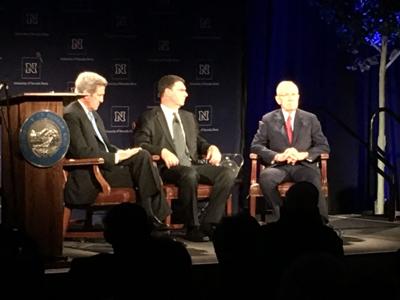



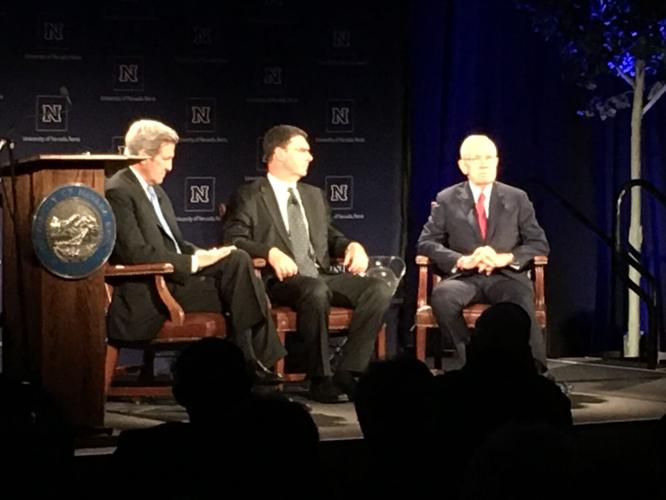
Harry Reid and John Kerry are no strangers to politics. Both were elected to the U.S. Senate in the 1980s and saw a lot of changes in government. Speaking in front of a packed room in the Joe Crowley Student Union on the University of Nevada campus, they talked about how the senate used to be more bipartisan and lawmakers were more willing to compromise. It's much different today.
"Our democracy is in peril and that's scary," Harry Reid, D-Former Senate Majority Leader said. "There are people that if you add all their time in the senate together it would be over a couple hundred years."
Bipartisanship and public service was the them of the day, and both agree that something has to change.
"The rules of the senate are almost exactly the same rules they've been for the last 100 years.," John Kerry, D-Former Secretary of State said. "It's not the rules of the senate that get in the way. It's the people that get in the way."
Reid says part of the problem is the amount of money in politics.
"Money is everything in politics today," Reid said. " We're very close to what Russia is now. We're arriving at a point in our country where a few very, very rich individuals, rich families, maybe 10 at the most will control everything."
Reid and Kerry agree that the best way to change Washington is to show up at the polls on election day.
"You reverse it by throwing people out of office who are unwilling to do their job," Kerry said.
Reid says he opposes voter ID laws because they make it more difficult to vote, and that there is not any evidence of voter fraud to require it.
"I'm in favor of same-day registration," Reid said. "I'm in favor of automatic registration. I think it's so important to get everybody to vote."
Kerry says the country needs more people to get involved with public service, whether that is in government or as an activist.
"In America, you do not go to jail because you stand up on a soapbox and tell it like it is," Kerry said. "That's a privilege and we need more people to exercise it."
Reid commended Kerry's work to combat global warming, who says more needs to be done to keep the earth's temperature from rising.
"In the last three years, each year more money has been invested in alternative, renewable, sustainable energy than in fossil fuel for the first time in history," Kerry said. "We're moving in the right direction, but we're not moving fast enough. That's the problem."
Kerry criticized President Trump for pulling out of the Paris Climate Agreement, but says people are moving forward with those principles at the local and state levels.
"We are more than halfway to Paris today," Kerry said. "I'm telling you, Donald Trump may have pulled out of Paris, but the American people are in Paris and we're still going to meet the agreement."
Along with renewable energy, Kerry says more has to be done to improve America's transportation system.
"Each billion dollars you put into infrastructure, folks, is somewhere between 27,000 and 35,000 jobs, and they're good-paying jobs," Kerry said. "So I think if we focus on that, we change our politics."
Reid and Kerry agree that the U.S. has to work with other countries from around the world.
"Isolationism doesn't work," Reid said. "We're a world economy, we're a world that has no boundaries anymore and so we have to be part of it."
People on-hand say they enjoyed hearing from the former Majority Leader and Secretary of State, saying that they touched on a lot of topics that could affect our country now and in the future.
"I think it's really important for, especially young people, to be civically engaged and know what's going on and be able to learn from our public leaders," Meghan Jonas, University of Nevada Freshman said.
"We just all need to join under the same boat of Americans," Henry Stone, University of Nevada Freshman said. "We just need to get together and solve issues as a country instead of as two separate parties."
This was the first of the Harry Reid Engagement Lecture Series. It will be held once every two years to honor Reid for his contributions to the university and the state.