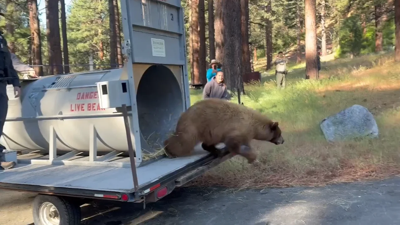
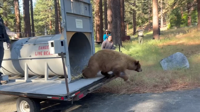

Wildlife officials captured a bear near downtown Reno on Thursday. It was released back into the wild early Friday morning.
"We had been following closely kind of her movements for the last couple of days, and she just kept going deeper into Reno," said Becca Carniello, a Game Biologist for NDOW. "At that point, it was time for us to intervene and get her back out of the city."
The Nevada Department of Wildlife says when a bear is spotted in a city, they have two main priorities: keeping the bear, and the population safe.
The two-year-old female black bear was spotted near Keystone Avenue but needed to get back into her natural habitat safely.
"This bear had gotten into a location that was pretty high risk for her to be injured by a car," said Carniello. "Black bears face much higher mortality risk when they're coming into human dominated areas. It's also very likely that they will have unlimited access to human foods. So, it was in the best interest of this bear to capture her at that point."
This specific bear was unknown to NDOW before her capture, meaning she hadn't caused any problems or been captured previously. Carniello says her behavior was not threatening to the public, which helped inform the team on how to capture her and what release tactics to use.
NDOW says every capture and release is based on the individual bear. In this situation, the black bear was in a tree in a populated area.
"What happens when we catch a bear that seems pretty comfortable around people is we are trying to give them a negative experience with people, rather than all the positive ones that they have been experiencing up to that point," said Carniello. "We turn those positive experiences into a negative one by using the dogs to create a very stressful situation for the bear. It's a little bit of tough love. The dogs are barking. We open up the trap door. We give the bear a little bit of a head start, and then we use the dogs off leash to chase them and put them in the cover or put them up a tree."
NDOW knew it had never captured this bear before, because each captured bear is tagged and she didn't have any yet. Carniello says if there's a bear in a city, it can generally be attributed to one thing.
"It mostly means that humans are not doing a great job of keeping their attractants secure. So, we have all of these abandoned super high calorie foods, and we are bringing bears into town, by making those available to them," said Carniello.
If this bear comes back into the city, she might have to be captured again. As long as her behavior is still non-threatening, she'll be released back into the wild.
The bear was released at Davis Creek Regional Park. The campground was picked because it has been closed to the public since the Davis Fire in 2024, limiting any interaction with people besides the release team.
If a bear is spotted in a person's yard from a safe distance, NDOW says yelling at the bear can make it feel uncomfortable and it will likely leave.
"If you hear a noise outside in the middle of the night, always try to make some noise. You want to give that animal a chance to get away. They really don't want to confront us. So, if we give them an opportunity, they will leave," said Carniello. "If you have that encounter with the bear in your yard and it's really unexpected, never run away. Always remain facing the bear. If the bear does not approach you, then you can start backing away towards your house. But never run. Always speak firmly. Always remain facing the bear."
If someone were to encounter a bear on a trail and the bear doesn't notice, they should remain quiet, and back away slowly. But if the bear does notice, it's important for that person to stand their ground and again, speak firmly. Then slowly back away if the bear doesn't approach. If a bear does approach, NDOW says to act aggressively towards it by waving arms and continuing to yell and avoid moving backwards until they stop approaching.
A two-year-old female black bear was spotted near keystone avenue Thursday but needed help to get back into her natural habitat safely.