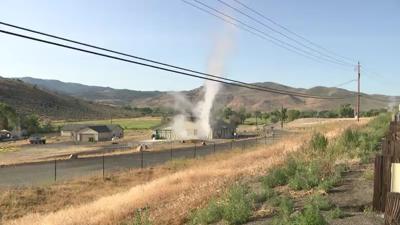



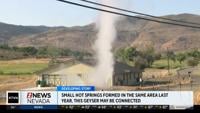

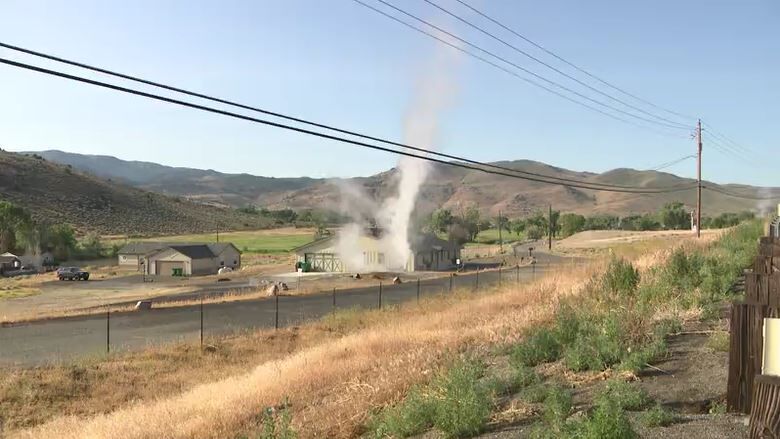
It’s a fitful, intermittent eruption that’s happening for a 30-foot ‘geyser’ spouting boiling water on a small property off Alternate 395 South Virginia Street.
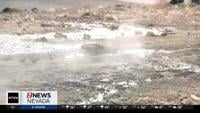
The water is coming from a pipe next to a long fissure in the ground – a fissure that geologists started studying last year when it became home to a collection of springs spewing hot bubbling water, less than a foot tall.
“The fissure has been there for a very long time, but it’s been dry,” Rachel Micander, Geologic Information Specialist with the Nevada Bureau of Mines and Geology, explained to 2 News Nevada on Friday. “Last year, in March, we came down and noticed that it was doing what we call perpetual spouting – there was this water, boiling water, coming out of the ground, spouting. Jim Faulds called it a mini geyser.”
She and other scientists studying the area believe that this new geyser is connected to those bubbling water spouts.
It began erupting Sunday afternoon, June 1, and spouted water for about 24 hours by resident reports, before the area completely dried up – including the small spouts nearby. As of Thursday night, it’s erupting again.
Though it’s an interesting and scientifically significant sight, scientists are warning the community not to visit. Micander measured the water temperature at 95 degrees Celsius – over 200 degrees Fahrenheit.
“This can cause third-degree burns. It can kill you,” she said. “Also, the ground in that area is incredibly unstable. There’s hot water flowing all underneath it, and because this geyser is unpredictable, the ground is unpredictable.”
Micander and other geologists aren’t sure what’s behind the geyser activity. She’s currently studying documents outlining the property’s history and permits, to see if they hold clues to what’s facilitating the water’s path to the surface now.
Contrary to rumors, she and other scientists don’t believe that the geyser activity is connected to the geothermal plant up the street, operated by Ormat Technologies. According to Micander, Ormat operates on a closed system at a higher elevation – the water that’s pumped out is reinjected.
The geysers at Steamboat have also been around for decades more, and disappeared long before any geothermal activity nearby. Eruptions weren’t uncommon a century ago. Why the land dried up, and why the water is returning now are questions that Micander and others are studying.
“Geysers operate on a very delicate system. They have things that they need to do geyser things, and if one of those things is out of whack – it could be water, it could be pressure, it could be heat – then you’re not going to have a geyser,” she said.
After the site dried out on Tuesday, Micander almost thought that was the last of it – that South Reno’s geysers had officially disappeared once again. But as long as this new, impressive spout continues to erupt, it may hold more clues to the history and future of the hot water just beneath the South Reno’s surface.