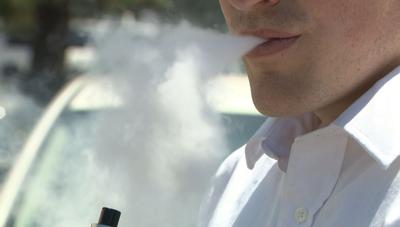

Many smokers use e-cigarettes to try and quit conventional tobacco, but popularity has also risen among those who have never smoked before. Until now, there was little evidence to determine the safety of these devices.
Now, a new pilot study from the Desert Research Institute and the University of Nevada, Reno gives some insight. The study shows that significant amounts of carcinogens, or cancer causing chemicals, are absorbed by the user after vaping.
Research professors analyzed the breath of more than a dozen e-cigarette users. Subjects were asked to breathe air into a sealed bag, before and after vaping, to test aldehyde concentrations in their breath. Vera Samburova Ph.D, Associate Research Professor at DRI says, "Toxic aldehydes is, in exhaled breath of e-cigarette users, higher than in their breath without vaping."
Additionally, the concentration of chemicals like formaldehyde in the user's breath, after vaping, was hundreds of times lower than what is found in a pure puff of direct e-cigarette vapors. So where does that dangerous carcinogen go? Andrey Khlystov, Ph.D, Research Professor at DRI says, "It stays in the lungs, in the respiratory tract."
Samburova adds, "Approximately 99% of aldehydes were in the lungs, because we compared concentration that was generated directly from e-cigarettes that they used, vs. the concentrations in what they exhale during the experiment."
So, is vaping any safer than smoking? Experts say they may be safer than traditional cigarettes since they don't contain tobacco or tar; but, Khlystov adds, "In terms of formaldehyde emissions, they are as bad and sometimes even worse than conventional cigarettes."
Researchers say e-cigarettes can be a useful tool to cut down on traditional smoking, but warn against using the device otherwise, since they say it can cause nicotine addiction. Samburova says using e-cigarettes before smoking, can even lead to smoking regular cigarettes in the future because of that.
The professors added that much more research, with larger sets of participants is needed, to really understand the full health effects of vaping. They're applying for National Institute of Health grants to get more funding.
To see the full pilot study, click here.