







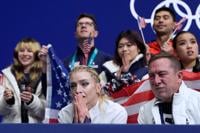





MILAN (AP) — It seemed only fitting that Ilia Malinin was the first one to get his Olympic gold medal after the U.S. successfully defended its team title by holding off the Japanese on Sunday night in the three-day competition at the Milan Cortina Games.
After all, everything came down to him in the end.
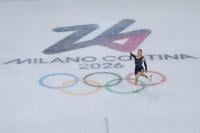
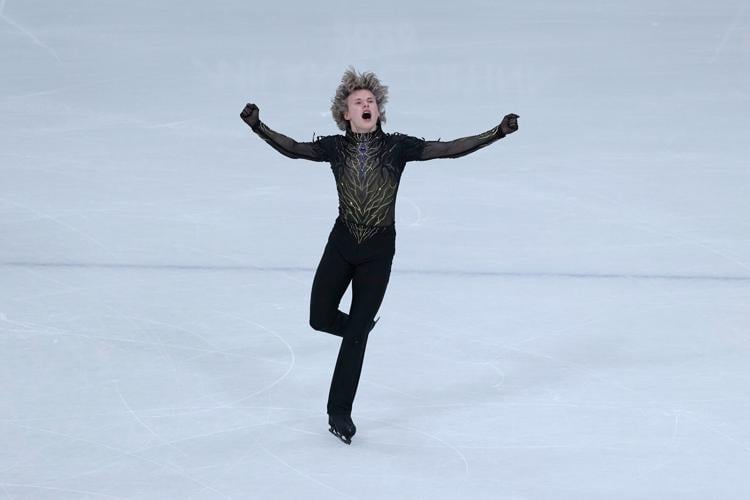
With the teams tied after seven of eight performances, Malinin calmly delivered for the Americans. The 21-year-old nicknamed the “Quad God” landed five quadruple jumps and scored 200.03 points for his free skate, atoning for a mediocre short program — at least by his lofty standards — one night earlier. That was enough to beat Japanese sensation Shun Sato, who followed him to the ice, hit a trio of quads of his own, but could only manage 194.86 points in finishing second.
The U.S. finished with 69 points while Japan had 68, earning the silver medal for the second consecutive Olympics.
“I was like, ‘OK, I’m the deciding factor,'" Malinin said later, after the U.S. got the medal ceremony it was denied at the Beijing Games, when Russian doping held up their awards for more than two years. “'I need to just, you know, do what I need to do.'”
Malinin does it better than anyone in the world.
Matteo Rizzo delivered one of the best free skates of his career as Italy was trying to hold onto the bronze medal, allowing the host nation to finish third with 60 points. Georgia was fourth with 56 and still has never won a Winter Olympics medal.
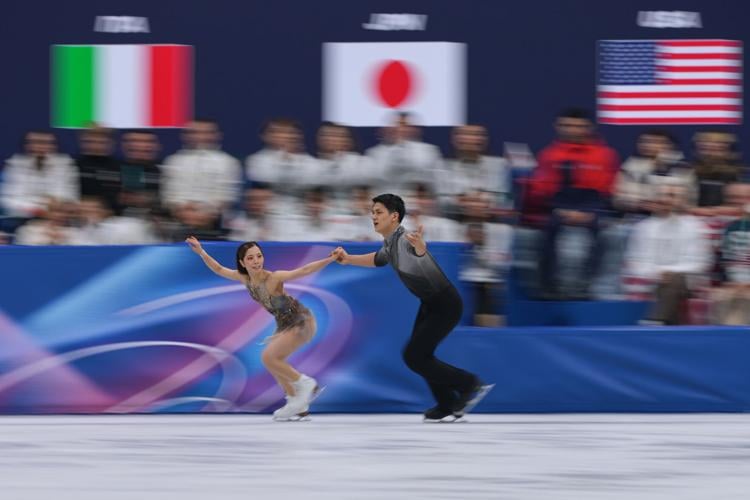
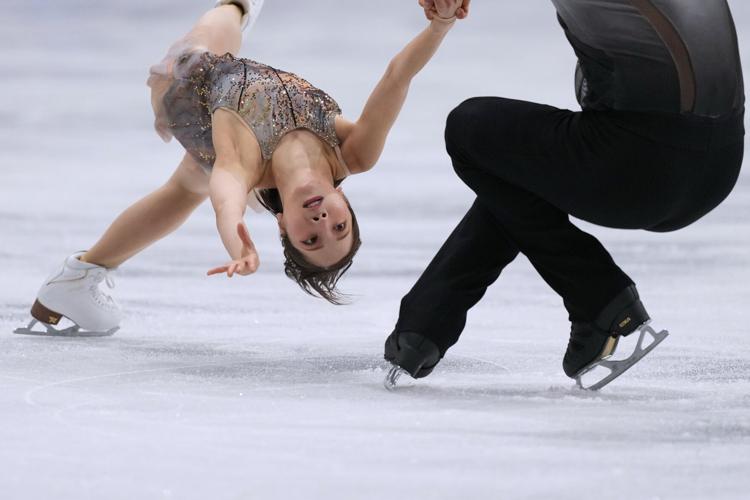
The U.S. had a five-point lead over Japan after two days of competition. But the advantage dwindled to nothing when world champions Riku Miura and Ryuichi Kihara won the pairs free skate and Kaori Sakamoto won the women's free skate earlier Sunday night.
Leave it to the best closer in the business to come through for the Americans.
Malinin opened with a big quad flip, opted for a safer triple axel over his quad, and overcame a couple of mistakes along the way to finish with aplomb. The son of Olympic skaters Tatiana Malinina and Roman Skorniakov ended with back-to-back combos, a quad toe-triple flip and a quad salchow-triple axel, leaving a crowd full of American and Japanese fans roaring in approval.
“I knew that it was going to be a tiebreaker between the men’s event,” Malinin said, “so I really just went straight into this, and just went for it. It went exactly the way I wanted, the way I planned. And you know, I'm so thankful for that.”
It wasn't quite over yet. Sato did everything he could to give Japan a chance.
From his opening quad lutz to his finishing triple lutz, Sato was nearly perfect, producing an easier but cleaner program than Malinin had earlier. He pumped his fist the moment his music ended, then had to wait to hear whether it was enough.
It wasn't quite.
“I didn't really think about whether or not I could beat Ilia,” Sato said through a translator, “but I definitely wanted to do it.”
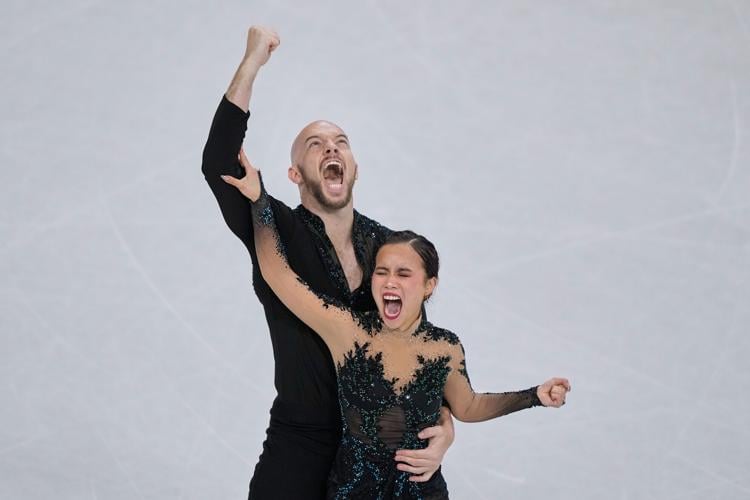
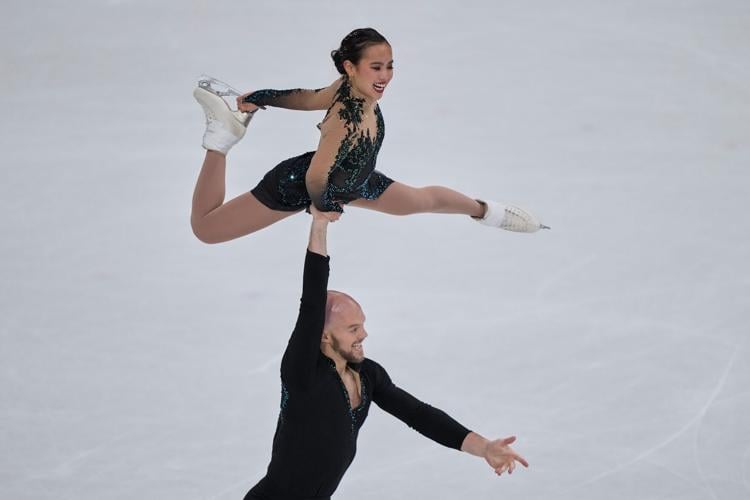
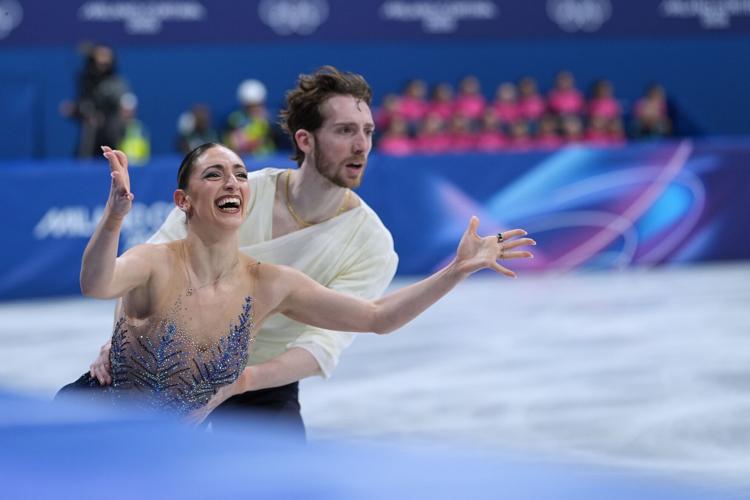
The pairs were first on the ice Sunday night, and Ellie Kam and Danny O'Shea put out the best free skate of their pairs career when the U.S. needed it the most, beating the Canadians to avoid dropping a much-needed point to the winning Japanese pairs team.
That point ended up being the margin of victory in the end.
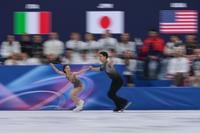
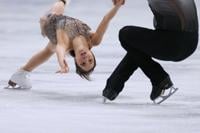
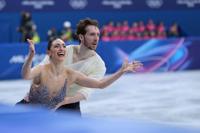
Kam and O'Shea scored 135.36 points for their program, which opened with “Sweet Dreams” by the Eurythmics and finished with “Everybody Wants to Rule the World” by Tears for Fears. Miura and Kihara won the segment with a career-best of their own of 155.55 points, pulling the Japanese within two points of the Americans with two events remaining.
“We couldn’t be more proud to be able to perform under what we felt was so much energy,” said the 34-year-old O’Shea, who was an Olympic alternate in 2018 but is making his debut at the Winter Games. "We walked into the day, walked into the rink with positive emotions, with an offensive attitude, and that showed out there on the ice."
Then the women took the stage with the U.S. swapping out world champion Alysa Liu for Amber Glenn.
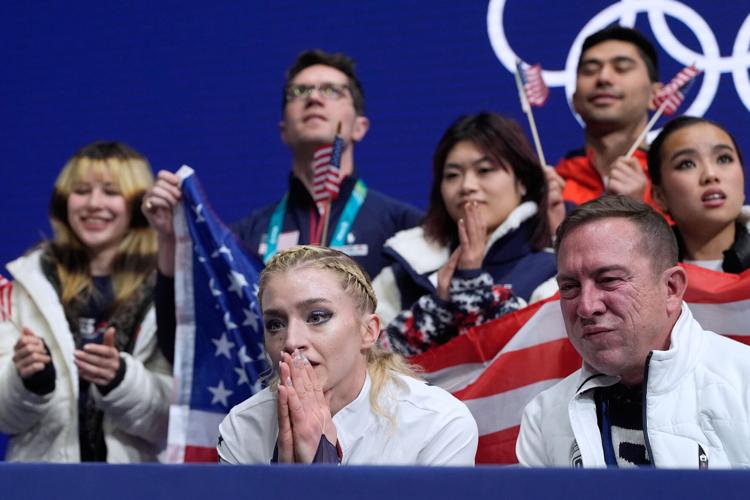
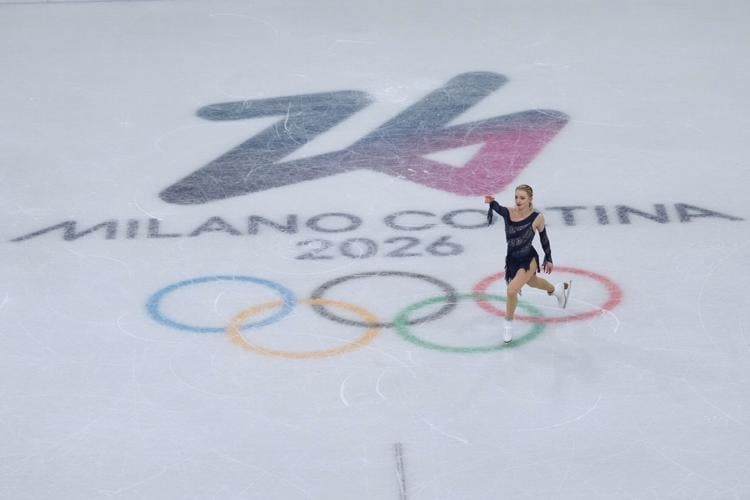
The three-time national champion spun out of her opening triple axel, the most difficult triple jump and one only she tried among the women, and Glenn had to add a late double toe loop after missing an earlier triple as part of a combination. Those two mistakes, and a couple of other errors along the way, left her with 138.62 points — and more crucially, third in the segment.
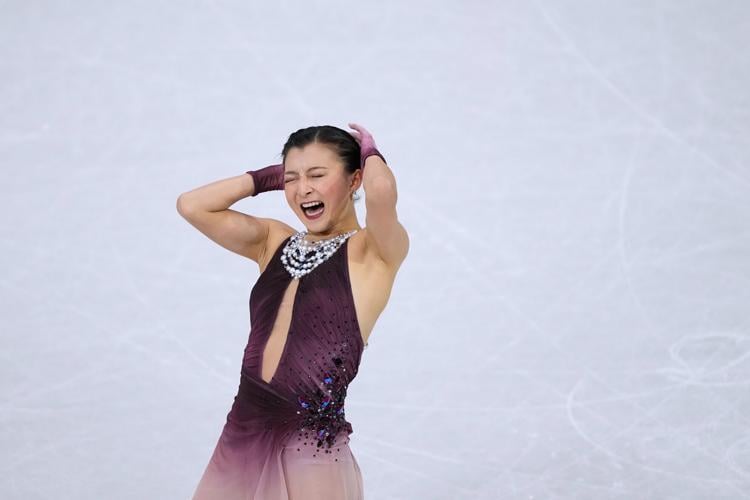
Kaori Sakamoto, the individual bronze medalist at the Beijing Games, won the free skate with 148.62 points, pulling Japan into a tie for the lead. Anastasiia Gubanova took second in the free skate as she tried to keep Georgia in the race for bronze.
“If an average person were to watch, they’d probably be like, ‘Oh, it’s fine. Just a few little things,' but as skating people we know, there were many, many, many points left out on the table,” Glenn said. "I did not feel or perform the way I wanted to. I physically didn’t feel great. My legs were feeling heavy, I was tired, I just didn’t feel my best, and I’ve been practicing here incredibly.
“It wasn’t how I wanted to feel,” Glenn added. “The adrenaline was really up and I think I just crashed a little bit.”
Fortunately for her, Malinin was there to pick the entire American team up.
“All of us are just so thrilled for all the work you put into this,” he said. “We cannot be here without each other.”
AP Olympic coverage: https://apnews.com/hub/milan-cortina-2026-winter-olympics