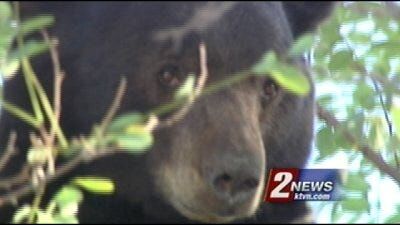
More bears are wandering into Nevada cities, as the animals try to fatten up before they go into hibernation. The Nevada Department of Wildlife says the surge in bear activity is a result of the ongoing drought. The drought has basically kept natural foods from growing in the bears' habitat. Between 400 and 700 bears live in the area and they would rather stay up in the mountains, away from people.
After three years of drought, NDOW knew this year had the potential for bears to come into contact with humans. They have already handled about 70 bears this year.
"It's certainly not something we want but it's certainly not something that has surprised us because we've seen this before," Chris Healy, NDOW spokesman said.
Bear activity typically rises during dry years, like in 2007, when they captured 159 bears. Starting in mid-September, bears go from eating 3,000 to 5,000 calories per day, to consuming 25,000 to 30,000 calories. That's why homeowners are encouraged to maintain their property.
"There's a lot of fruit trees that have mature fruit," Healy said. "If people don't harvest the fruit or they let it fall to the ground, well guess what? You're ringing the dinner bell for the bears."
One bear was spotted near a 7-Eleven, in old southwest Reno. Another one was hanging out near Keystone Avenue, in the Oxbow Nature Study area. Many people reported a bear, in Wingfield Springs. That is the first time a bear has been seen, in Sparks, since 1997.
"It was an unusual thing in 1997, and the sighting of a bear in Spanish Springs is an unusual thing in 2014," Healy said.
Fifteen bears have already died after being hit by cars, in Nevada, this year. That compares to just three in 2011, before the drought started.
"This is a 3-year drought," Healy said. "Hopefully it doesn't become a 4-year drought because then we'll be talking about this, maybe even more dramatically, next year."
NDOW has only had to euthanize two bears, this year. One was put down for public safety and one for killing livestock. Most captured bears have been released back into the mountains. "The last thing we want to do is have to euthanize a bear," Healy said. "Our goal is to keep our bears alive and wild."
Healy says some parents have voiced concerns about bears wandering around town, while kids are trick-or-treating, this Halloween. He says bears won't be attracted to pumpkins and candy, and they normally avoid groups of people, who are making noise. So, parents shouldn't have much to worry about.