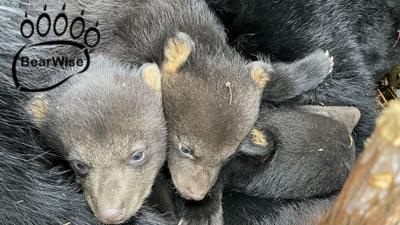

As black bears begin to emerge across Lake Tahoe with new cubs, wildlife experts are reminding people that what happens next is critical, not just for the bears’ survival, but for public safety, as simple actions like securing food and giving space can shape how these animals live and interact with people.
Across the Tahoe basin, mother bears are now leaving their winter dens with cubs that are only about eight to 10 weeks old.
What may seem sudden actually started nearly a year ago.
Black bears mate between June and August, but females go through a process known as delayed implantation. After fertilization, the egg forms a small cluster of cells, then pauses development, remaining in the uterus until the fall.
That pause gives the female time to build up fat reserves needed to survive the winter and support cubs during hibernation.
As food becomes scarce in the fall, bears enter a period of heavy feeding known as hyperphagia, consuming about 25,000 calories a day. This allows them to store enough energy for the months ahead.
Once winter arrives, bears enter hibernation, or torpor, a state where they do not eat or drink. They also do not urinate or defecate, instead relying on stored fat and recycling waste into usable proteins. During this time, their heart and metabolic rates drop, and they can lose between 25% and 40% of their body weight.
For females, the process becomes more selective. In late fall, the body determines whether there is enough stored fat to sustain both the mother and potential cubs. If there is, the embryo implants and development begins. If not, the pregnancy ends, and the embryo is reabsorbed.
Around early February, a pregnant female gives birth inside the den to one to four cubs. The newborns are blind, hairless, and weigh less than one pound. The mother remains mostly in torpor, briefly waking to care for them and allow them to nurse.
By the time they emerge from the den between March and May, the cubs typically weigh five to seven pounds.
During their first year, cubs stay with their mother, learning how to find food and avoid danger. They rely on her for several months and are taught to forage for natural foods like grasses, berries, and insects.
They remain with their mother through their first winter, emerging the following spring as yearlings that can weigh between 50 and 150 pounds before eventually going off on their own.
Bears play an important role in the Lake Tahoe ecosystem. Their diet is mostly plant-based, and they help spread seeds, move pollen, and recycle nutrients by feeding on insects and carrion.
Officials say human behavior can disrupt that natural cycle.
When bears gain access to human food or garbage, mothers can pass those habits on to their cubs. That can increase the risk of conflict, including being hit and killed by cars, and reduce their ability to forage in the wild.
People are encouraged to give bears space and secure food and trash to help keep them wild.
For more information about black bear reproduction and cubs, visit BearWise: Birthday Time for Bears. For more information on coexisting with bears, visit BearWise.org or TahoeBears.org.
To report human-bear conflicts:
In California, contact the CDFW at (916) 358-2917 or report online using the Wildlife Incident Reporting (WIR) system at apps.wildlife.ca.gov/wir.
Non-emergency wildlife interactions in California State Parks can be reported to their public dispatch at (916)358-1300.
In Nevada, contact the NDOW at (775) 688-BEAR (2327).
If the issue is an immediate threat, call the local sheriff’s department or 9-1-1.
(The Tahoe Interagency Bear Team contributed to this story.)