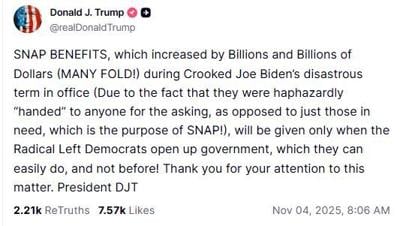

President Donald Trump caused some confusion earlier Tuesday when he appeared to threaten SNAP benefits unless Democrats voted to reopen the government — despite court orders mandating that the administration keep the nation’s largest food program running.
Press secretary Karoline Levitt said Tuesday the administration continues to pay out SNAP funding using contingency funding, which is what two separate judges ordered on Monday. The U.S. Department of Agriculture had planned to freeze SNAP payments starting Nov. 1 because of a lapse in funds during the government shutdown.
In a social media post Tuesday morning, Trump said SNAP benefits had been handed out “haphazardly” under his predecessor.
SNAP benefits “will be given only when the Radical Left Democrats open up government, which they can easily do, and not before!” Trump added.
The government says the emergency fund it will use has enough to cover about half the normal benefits. Leavitt said Trump “does not want to have to tap into this fund in the future,” which is what he meant by his social media post earlier in the day.
"SNAP BENEFITS, which increased by Billions and Billions of Dollars (MANY FOLD!) during Crooked Joe Biden’s disastrous term in office... will be given only when the Radical Left Democrats open up government, which they can easily do, and not before!" - President Donald J. Trump pic.twitter.com/VvPP6DU2qH
— The White House (@WhiteHouse) November 4, 2025

The president's social media post comes on Day 35 of the shutdown, now tying the record for the longest government shutdown ever.
The U.S. Department of Agriculture had planned to freeze payments to the Supplemental Nutrition Assistance Program starting Nov. 1 because it said it could no longer keep funding it due to the shutdown. The program serves about 1 in 8 Americans and is a major piece of the nation’s social safety net. It costs about $8 billion per month nationally.
It’s not clear how much beneficiaries will receive, nor how quickly beneficiaries will see value show up on the debit cards they use to buy groceries. The process of loading the SNAP cards, which involves steps by state and federal government agencies and vendors, can take up to two weeks in some states. The average monthly benefit is usually about $190 per person.
The U.S. Department of Agriculture, which oversees the nation’s largest food program, said last month that benefits for November wouldn’t be paid out due to the federal government shutdown. That set off a scramble by food banks, state governments, and the nearly 42 million Americans who receive the aid to find ways to ensure access to groceries.
To qualify for SNAP in 2025, a family of four’s net income after certain expenses can’t exceed the federal poverty line, which is about $31,000 per year.
The Nevada Interim Finance Committee has approved $30 million in funding for local food banks.
"We are very happy that the state is committed to food insecurity and fighting that, and that they are looking at this contingency funding, and they have made a commitment to help us on a certain level,” says Jocelyn Lantrip, marketing director, Food Bank of Northern Nevada.
In addition - the committee also agreed to use $200,000 to have the National Guard help by boxing and transporting food to distribution sites.
Catholic Charities of Northern Nevada is also offering a free hot dinner at St. Vincent’s Dining Room, located at 325 Valley Road in Reno, this Nevada Day weekend.
Dinners will be served Friday, Saturday, and Sunday from 4:00 to 5:30 p.m., and will continue every Saturday and Sunday evening through the end of November. Guests are asked to bring their EBT card and a photo ID to verify eligibility for the dinner meal. Meals will be served on a first-come, first-served basis, while supplies last.
As a reminder, St. Vincent’s Dining Room remains open daily, serving lunch to all who are hungry from 11:30 a.m. to 1:00 p.m., 365 days a year.


NV Energy says it is stepping up to help Nevadans affected by the federal government shutdown and with the SNAP uncertainty.
NV Energy says they will waive late fees and offer payment plans for customers impacted by the shutdown and losing SNAP benefits. The utility says their foundation is also providing $350,000 in funding to Nevada food banks.
Another resource available is Nevada’s Weatherization Assistance Program, which helps income-qualified families lower utility bills through free home energy upgrades. For full story details, click here.
Other resources include:
Nevada 2-1-1 (Statewide Food Assistance Resource)
Overview: Free, confidential, statewide service connecting residents to food assistance programs, pantries, meals, SNAP/EBT support, and other essential resources.
How to Access:
Dial 2-1-1 or 1-866-535-5654 (toll-free).
Text your ZIP code to 898-211 for location-specific assistance.
Visit the Food Services Finder online to locate nearby pantries, emergency food programs, senior meals, and more.
Website: nevada211.org/food-services
Food Bank of Northern Nevada (FBNN)
Overview: Central hub distributing food to pantries and running mobile-community programs. Serves all ages, with emphasis on fresh produce and staples. No ID required for most distributions; first-time visitors complete a brief intake form (confidential.
- Mobile Harvest: Weekly drive-thru distributions of fresh fruits, vegetables, and pantry staples. Open to all; one visit per household, per week. Arrive one hour early.
- Schedule: Download PDF at www.fbnn.org/gethelp for Washoe County locations (e.g., parks, schools, community centers in Reno/Sparks).
- Neighborhood Pantries: Over 70 partner sites (churches, schools, community centers), offering grocery bags. Hours vary; full list with schedules at fbnn.org/gethelp/neighborhoodpantry.
- Senior Nutrition & Wellness (SNW, formerly CSFP): Monthly boxes of staples for low-income seniors 60+. The income level for one person is $1,957 and for 2 people it is $2,644. Requires proof of income, NV residency, and photo ID. Annual certification in July.
- Schedule (October/November 2025): Washoe County PDF.
- Produce on Wheels: Fresh produce for seniors 60+. Same eligibility as SNW.
- Schedule: Washoe County PDF.
- Kids Café: Free meals (breakfast/lunch) for kids up to age 18 at ~20 sites (e.g., after-school programs, schools). Parents must show child ID or provide name/age. Check fbnn.org/gethelp/foodfinder for locations.
- TEFAP (Emergency Food Assistance Program): USDA commodities at select pantries for income-eligible households (limits similar to SNW).
The Regional Transportation Commission (RTC) of Washoe County is helping families access food resources by donating 3,000 two-ride adult bus passes to the Washoe County School District.


Meanwhile, CBS News reports that the Senate failed Tuesday to pass a House-passed funding bill for the 14th time. A procedural vote on a measure to fund the government until Nov. 21 fell short of the 60 votes needed in a 54 to 44 vote.
“Enough is enough,” said Senate Majority Leader John Thune, the South Dakota Republican, as he opened the deadlocked chamber.
The measure saw no new support from Democrats on the 14th vote.. Democratic Sens. Catherine Cortez Masto of Nevada and John Fetterman supported advancing the measure, along with independent Sen. Angus King of Maine, who caucuses with Democrats. GOP Sen. Rand Paul of Kentucky was the sole Republican to oppose.
Democratic Sen. Cory Booker of New Jersey and GOP Sen. Thom Tillis of North Carolina did not vote.
White House won't engage on health care until government reopens
The White House says its position remains unchanged and that Democrats must vote to fund the government until talks over health care can begin. White House officials are in close contact with GOP senators who have been quietly speaking with key Senate Democrats, according to a senior White House official. The official was granted anonymity to discuss administration strategy.
With insurance premium notices being sent, millions of Americans are experiencing sticker shock on skyrocketing prices. The loss of federal subsidies, which come in the form of tax credits, are expected to leave many people unable to buy health insurance.
Republicans, with control of the House and Senate, are reluctant to fund the health care program, also known as Obamacare. But Thune has promised Democrats a vote on their preferred proposal, on a date certain, as part of any deal to reopen government.
That's not enough for some senators, who see the health care deadlock as part of their broader concerns with Trump's direction for the country.
“Trump is a schoolyard bully,” said Sen. Bernie Sanders, the Independent from Vermont, in an op-ed. “Anyone who thinks surrendering to him now will lead to better outcomes and cooperation in the future does not understand how a power-hungry demagogue operates.”
Moreover, Democrats, and some Republicans, are also pushing for guardrails to prevent the Trump administration's practice of unilaterally slashing funds for programs that Congress had already approved, by law, the way billionaire Elon Musk did earlier this year at the Department of Government Efficiency.
With the Senate, which is split 53-47, having tried and failed more than a dozen times to advance the House-passed bill over the filibuster, that measure is out of date. It would have funded government to Nov. 21.
Trump has demanded senators nuke the filibuster, the Senate rule that requires a 60-vote threshold to advance most legislation, which preserves minority rights in the chamber. GOP senators panned that demand.
Both Thune and Johnson have acknowledged they will need a new temporary measure. They are eyeing one that skips past the Christmas holiday season, avoiding what often has been a year-end crunch, and instead develop an agreement that would keep government running into the near year, likely January.
(CBS News, and The Associated Press contributed to this report.)