Two federal judges have ruled that the Trump administration must continue to fund the SNAP food aid program using contingency funds during the government shutdown.
The rulings Friday came a day before the payments were due to be halted.
SNAP is used by 1 in 8 Americans to buy groceries and is a major piece of the nation’s social safety net.
The administration said it couldn’t pay for it with the government shuttered.
Democratic state officials challenged the plan to freeze SNAP payments starting Nov. 1, saying there’s a legal obligation to keep providing the assistance for low-income people.
A federal judge in Rhode Island ruled from a bench that the program must be funded using at least the contingency funds – and asked for an update on progress by Monday.
A Massachusetts-based judge also gave the administration until Monday to say whether it would partially pay for the benefits for November with contingency money or fund them fully with additional funds. The suit was brought by two dozen states, including Nevada and the District of Columbia earlier this week.
Nevada Attorney General Aaron D. Ford released this statement after the Massachusetts ruling:
"The court's decision is clear — the Trump administration must use the contingency fund to ensure SNAP benefits continue through this government shutdown. The USDA has until Monday, Nov. 3 to decide how to proceed with this order, said Attorney General Ford. “I will always fight to ensure Nevadans do not wonder where their next meal is coming from. And I will continue this legal fight as long as it takes to ensure that no Nevadan goes hungry."

The Trump Admin’s cruel attempt to withhold SNAP funding is illegal and I’m glad to see two federal judge have agreed. Trump must distribute food assistance funds ASAP before tomorrow's deadline to make sure no Nevadan goes hungry. https://t.co/eaZbodJJPH
— Senator Jacky Rosen (@SenJackyRosen) October 31, 2025
Congressman Steven Horsford (D-NV) released the following statement after the Rhode Island ruling.
“It’s a dark day when it takes a federal judge’s ruling to stop this administration from harming its own people, but that’s where we are,” Rep. Horsford said. “I’m grateful that Judge McConnell applied the law clearly and validated the Congressional intent of the SNAP emergency fund. I urge the Trump administration to adhere to Judge McConnell’s ruling immediately – 500,000 Nevadans who rely on SNAP deserve better than to have elected leaders use them as political pawns.”
It wasn’t immediately clear how quickly the debit cards that beneficiaries use to buy groceries could be reloaded after the ruling. That process often takes one to two weeks.
The rulings are likely to face appeals.
Even with the rulings, many beneficiaries are likely to face delays in getting the debit cards they use to buy groceries reloaded. That process can take one to two weeks, so it's likely too late to get funds on cards in the first days of November.
Meanwhile, states, food banks and recipients have been bracing for an abrupt shift in how low-income people can get groceries.
The majority of states have announced more or expedited funding for food banks or novel ways to load at least some benefits onto the debit cards used in the program.
Advocates and beneficiaries say halting the food aid would force people to choose between buying groceries and paying other bills.
A push this week to continue SNAP funding during the shutdown failed in Congress.
To qualify for SNAP in 2025, a family of four’s net income after certain expenses can’t exceed the federal poverty line, which is about $31,000 per year. Last year, SNAP provided assistance to 41 million people, nearly two-thirds of whom were families with children, according to the lawsuit
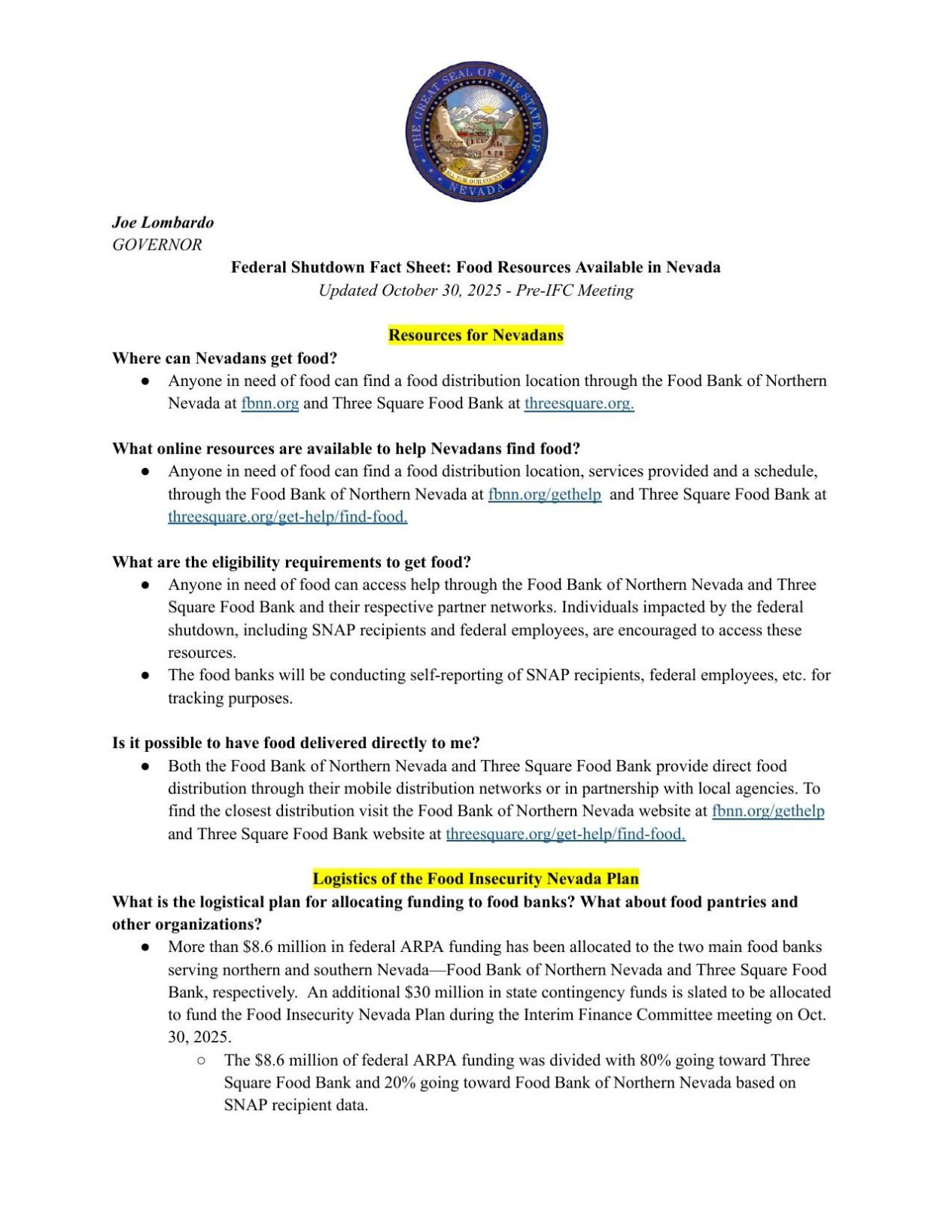
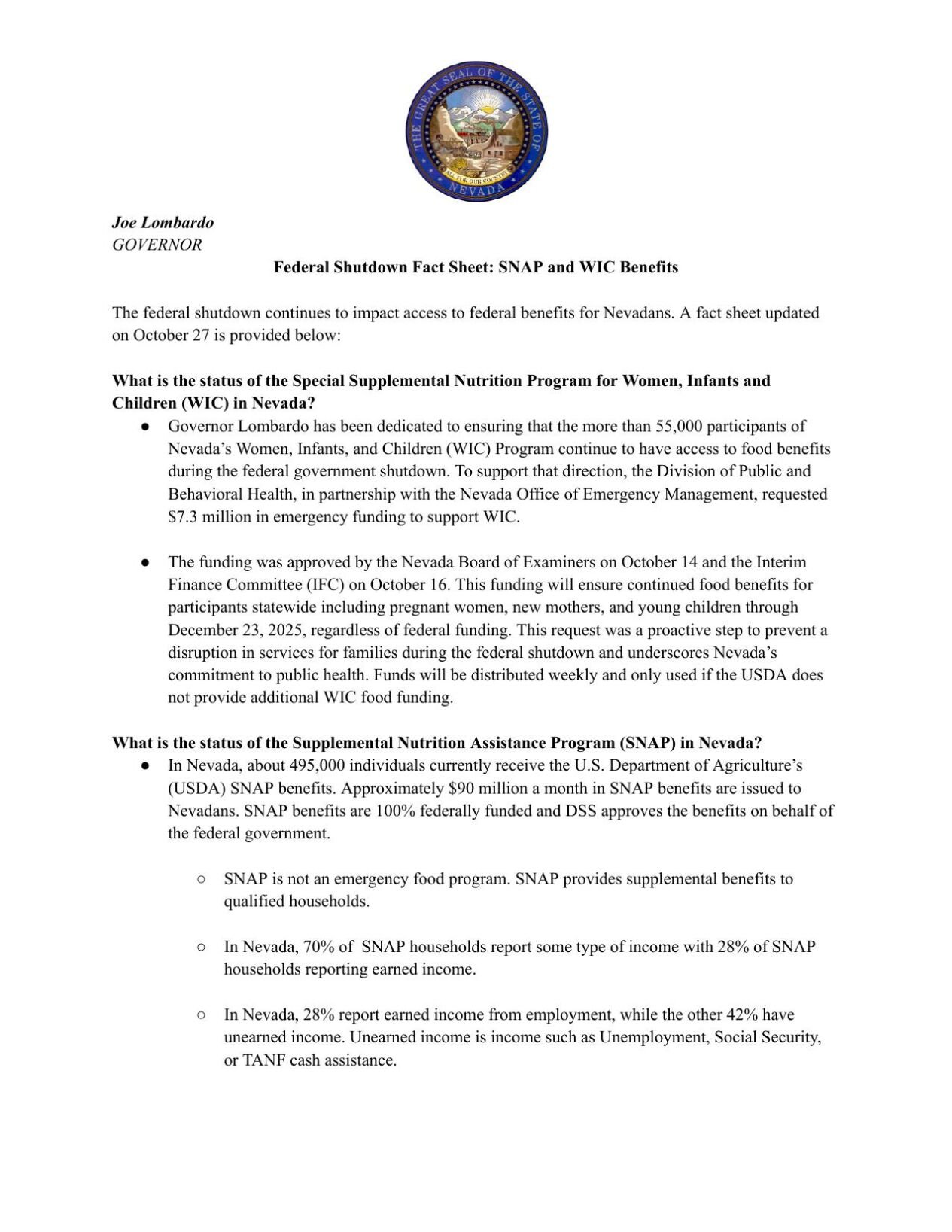
The Nevada Interim Finance Committee has approved $30 million in funding for local food banks.
"We are very happy that the state is committed to food insecurity and fighting that, and that they are looking at this contingency funding, and they have made a commitment to help us on a certain level,” says Jocelyn Lantrip, marketing director, Food Bank of Northern Nevada.
In addition - the committee also agreed to use $200,000 to have the National Guard help by boxing and transporting food to distribution sites.
The Food Bank of Northern Nevada is teaming up with Catholic Charities to offer four different distribution events this weekend to help people who may be affected during the government shutdown.
Food will be distributed this Saturday, November 1 from 9 a.m. through 1 p.m.
At the Food Bank of Northern Nevada, the pick-up will be in the form of a drive-up and a walk-up option for people without vehicles.
Catholic Charities will also have three locations at the Moana Neighborhood Center, Sun Valley Neighborhood Center, and the St. Rose of Lima Church location.
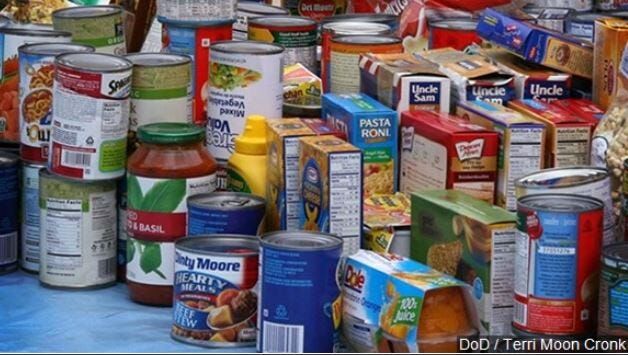

Catholic Charities of Northern Nevada is also offering a free hot dinner at St. Vincent’s Dining Room, located at 325 Valley Road in Reno, this Nevada Day weekend.
Dinners will be served Friday, Saturday, and Sunday from 4:00 to 5:30 p.m., and will continue every Saturday and Sunday evening through the end of November. Guests are asked to bring their EBT card and a photo ID to verify eligibility for the dinner meal. Meals will be served on a first-come, first-served basis, while supplies last.
As a reminder, St. Vincent’s Dining Room remains open daily, serving lunch to all who are hungry from 11:30 a.m. to 1:00 p.m., 365 days a year.
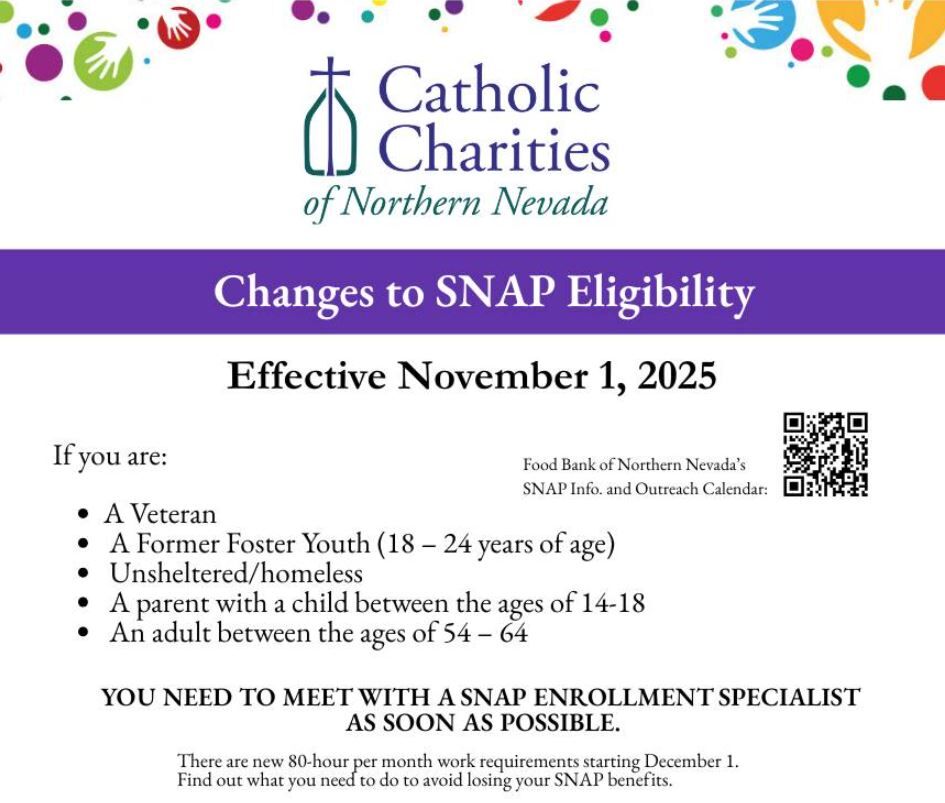


NV Energy says it is stepping up to help Nevadans affected by the federal government shutdown and with the SNAP uncertainty.
NV Energy says they will waive late fees and offer payment plans for customers impacted by the shutdown and losing SNAP benefits. The utility says their foundation is also providing $350,000 in funding to Nevada food banks.
Another resource available is Nevada’s Weatherization Assistance Program, which helps income-qualified families lower utility bills through free home energy upgrades. For full story details, click here.
Other resources include:
Nevada 2-1-1 (Statewide Food Assistance Resource)
Overview: Free, confidential, statewide service connecting residents to food assistance programs, pantries, meals, SNAP/EBT support, and other essential resources.
How to Access:
Dial 2-1-1 or 1-866-535-5654 (toll-free).
Text your ZIP code to 898-211 for location-specific assistance.
Visit the Food Services Finder online to locate nearby pantries, emergency food programs, senior meals, and more.
Website: nevada211.org/food-services
Food Bank of Northern Nevada (FBNN)
Overview: Central hub distributing food to pantries and running mobile-community programs. Serves all ages, with emphasis on fresh produce and staples. No ID required for most distributions; first-time visitors complete a brief intake form (confidential.
- Mobile Harvest: Weekly drive-thru distributions of fresh fruits, vegetables, and pantry staples. Open to all; one visit per household, per week. Arrive one hour early.
- Schedule: Download PDF at www.fbnn.org/gethelp for Washoe County locations (e.g., parks, schools, community centers in Reno/Sparks).
- Neighborhood Pantries: Over 70 partner sites (churches, schools, community centers), offering grocery bags. Hours vary; full list with schedules at fbnn.org/gethelp/neighborhoodpantry.
- Senior Nutrition & Wellness (SNW, formerly CSFP): Monthly boxes of staples for low-income seniors 60+. The income level for one person is $1,957 and for 2 people it is $2,644. Requires proof of income, NV residency, and photo ID. Annual certification in July.
- Schedule (October/November 2025): Washoe County PDF.
- Produce on Wheels: Fresh produce for seniors 60+. Same eligibility as SNW.
- Schedule: Washoe County PDF.
- Kids Café: Free meals (breakfast/lunch) for kids up to age 18 at ~20 sites (e.g., after-school programs, schools). Parents must show child ID or provide name/age. Check fbnn.org/gethelp/foodfinder for locations.
- TEFAP (Emergency Food Assistance Program): USDA commodities at select pantries for income-eligible households (limits similar to SNW).
The Regional Transportation Commission (RTC) of Washoe County is helping families access food resources by donating 3,000 two-ride adult bus passes to the Washoe County School District.


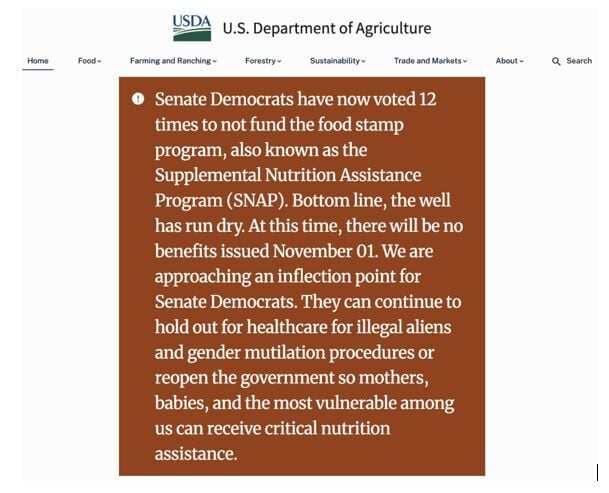
Earlier this week, the USDA posted a notice on its homepage saying that federal food aid will not go out on November 1.
“Bottom line, the well has run dry,” the USDA notice says. “At this time, there will be no benefits issued on November 01. We are approaching an inflection point for Senate Democrats.” Nationally, the SNAP program helps about 1 in 8 Americans buy groceries.
The federal shutdown, which began Oct. 1, is now the second-longest on record.
(Office of Nevada Attorney General and Governor's Office, USDA, CBS News and the Associated Press contributed to this report.)