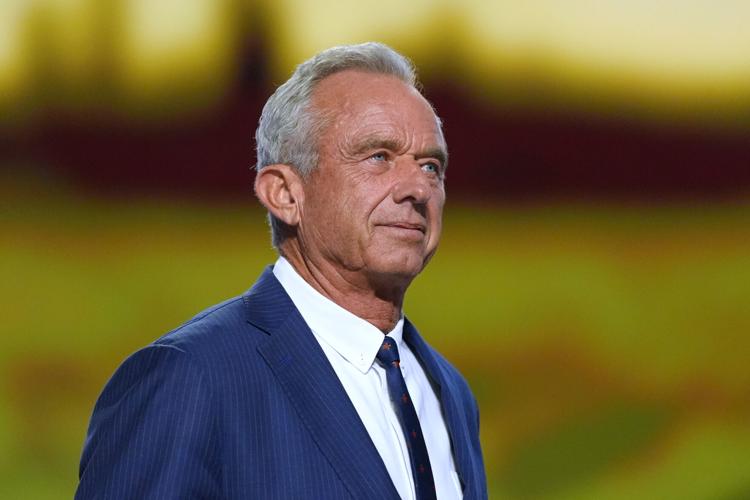


WASHINGTON (AP) — Health Secretary Robert F. Kennedy Jr. has built a national following by channeling the energy of Americans who are worried about the influence of corporations, including makers of vaccines, drugs, processed foodsand pesticides.
But last week the leader of the “Make America Healthy Again” movement threw his support behind an unlikely industry: artificial intelligence.
At a MAHA summit featuring AI and Silicon Valley executives, Kennedy declared that the technology would free Americans from “medical tyranny” by allowing them to “fact check their own medical advice.”
“We’re never ever again going to be able to be dominated by public officials who tell us: ‘Trust the experts,’” Kennedy told the invite-only audience.
Some prominent MAHA voices quickly criticized Kennedy’s embrace of AI, saying the movement's leaders are increasingly cozying up to the corporate interests they once scrutinized.
At the same time, medical experts say Kennedy’s vision of AI as a check against the medical establishment is fundamentally flawed.
“He obviously doesn’t understand how AI works,” said Dr. Zeke Emanuel, a cancer specialist and bioethicist at the University of Pennsylvania. “AI aggregates the information we have in the medical literature and in case studies. And that means what you’re actually getting is medical expertise.”
Both OpenAI and Anthropic offer health-focused chatbots that can analyze users' medical records and answer their healthcare questions. Their models are trained on thousands of peer-reviewed medical papers and professional guidelines and incorporate feedback from doctors.
“He wants AI to mimic what he says,” Emanuel said. “But that’s not what good AI is going to do.”
HHS spokesperson Emily Hilliard said Emanuel was describing “one narrow use” of the technology.
Kennedy wants to give Americans more control of their own health data by using AI “to help them understand it, interrogate it, compare it with the evidence, and make better decisions with their doctors,” Hilliard said. The technology will help doctors work faster, giving them “more time to treat and care for patients,” she added.
MAHA leader defends corporate sponsorships
OpenAI and Anthropic were among the sponsors of last week’s MAHA Summit. So were more than a dozen other companies with pending business before the U.S. government, including developers of psychedelic drugs, fitness wearables and an experimental cancer test.
Sponsors paid up to $300,000 and many received speaking slots on panels that included some of the administration’s top health officials, including Dr. Mehmet Oz of the Centers for Medicare and Medicaid Services.
“It was classic pay-to-play,” said Dr. Robert Malone, a vaccine researcher who has questioned the safety of mRNA shots and recently served on a federal vaccine panel under Kennedy.
Malone and other figures in the MAHA movement say the summit showed how big companies are replacing the “MAHA moms” and other grassroots activists who originally powered the movement.
“There was no representation of people that have been at the core of MAHA and its creation, whether it be physicians or patients or patient advocates,” Malone said.
The summit was organized by MAHA Center Inc., one of a number of nongovernment groups run by Kennedy associates that are dedicated to promoting his agenda. Others include the MAHA Institute, a think tank, and MAHA PAC, a political fundraising operation.
Tony Lyons, a publisher who runs the MAHA Center, MAHA PAC and several related groups, addressed criticisms about corporate sponsorships at a reception ahead of the summit.
“The truth is we’re trying to build the biggest movement we can possibly build to actually get things done,” Lyons said.
The Trump administration has embraced AI
Kennedy's alliance with Silicon Valley is consistent with broader efforts across the Trump administration.
President Donald Trump has vigorously resisted efforts to bring greater oversight to AI companies, who have helped drive the stock market to record highs. One of Trump’s first actions after returning to the White House was revoking a Biden administration executive order on AI oversight. It took the administration more than 16 months to replace it with its own order.
In recent weeks, Trump announced a move to let the AI industry police itself, tried to rebrand the technology as “super intelligence” and brushed aside bipartisan concerns about the impacts of data centers on nearby residents.
Meanwhile, Dr. Oz and other administration officials have touted AI as the answer to a litany of U.S. health problems, including rising medical costs, healthcare fraud, physician shortages and the shuttering of rural hospitals.
Medicare officials have been in discussions with several medical chatbot companies, including one behind a Utah program that provides AI-enabled refills of prescriptions.
The remarks from Kennedy and other officials last week reflect a “techno-utopian” view of AI’s potential benefits, says Glenn Cohen, a Harvard Law School bioethics expert.
Cohen notes that much of RFK’s agenda over the past year has focused on trying to curb food industry practices he views as harmful to consumers, including the use of artificial colors and undeclared chemical additives. Given Kennedy's skepticism of “big food,” Cohen said he was surprised the health secretary didn't see “the risk that market incentives may diverge from the public good.”
Some of the most prominent MAHA organizations are actively organizing against AI interests.
For example, Moms Across America operates local and national campaigns warning against pollution, water use and electricity costs associated with data center construction. The group was founded by Zen Honeycutt, a former staffer for Kennedy’s presidential campaign.
Moms Across America did not respond to a request for comment.
It's not yet clear how AI will integrate into US healthcare
AI experts don’t dispute that the technology will fundamentally change how doctors and patients approach medical decisions.
Kennedy is correct when he says AI will empower patients with more insights about their health, says Dr. Robert Wachter, a medical technology expert at University of California, San Francisco. But AI adoption is likely to further bolster the recommendations of medical professionals, rather than the contrarian views often favored by Kennedy, according to Wachter.
“Democratization is good,” Wachter said. “But that means disseminating the best science we have, which generally means science created by people who know what they’re talking about.”
Experts disagree over how soon AI may be able to take over decision-making from physicians.
Several recent studies have found that AI alone outperformed doctors working alone or doctors working with AI on critical decisions. But those studies generally presented AI with detailed, written scenarios to solve — the equivalent of a medical exam.
When researchers looked at how patients interact with AI in real-time they found a number of problems: People often don’t provide enough information for the AI to correctly diagnose their medical issue and chatbots often respond with a combination of good and bad advice.
“We need to figure out in real life: Do these things actually work?” Wachter said. “What actually happens when they’re used in circumstances where people are under stress or don’t know how to interpret the outputs?”
The Associated Press’ health and science coverage receives financial support from the AP Fund for Journalism and private foundations. AP is solely responsible for all content. Find AP’s standards for working with philanthropies, a list of supporters and funded coverage areas at AP.org.