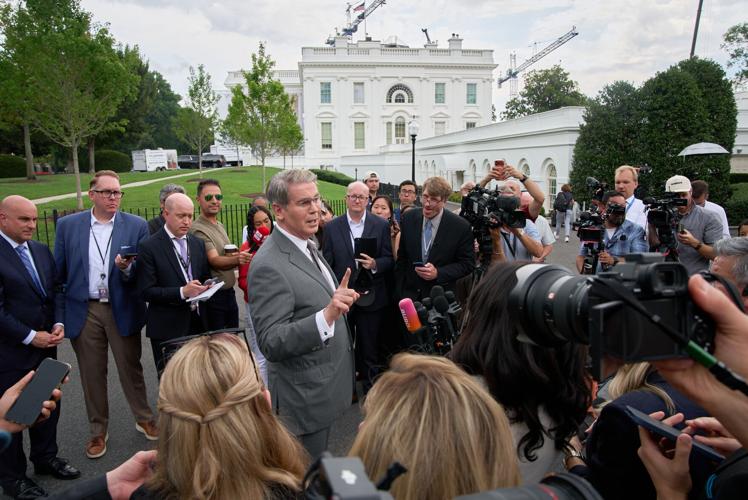






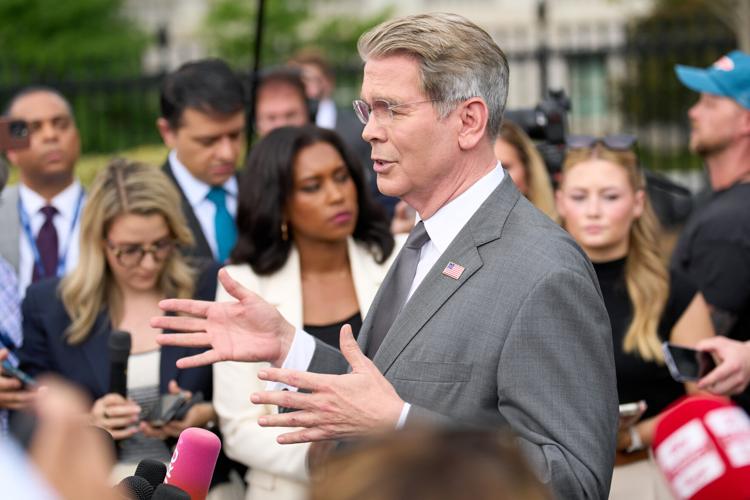
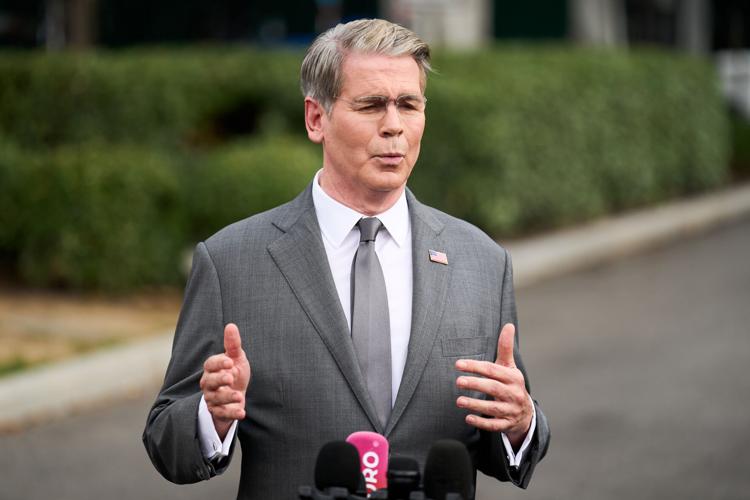
WASHINGTON (AP) — Interest rates rebounded Thursday despite efforts by Treasury Secretary Scott Bessent to put a lid on longer-term borrowing costs, a sign Wall Street investors remain worried about burgeoning government debt, heavy borrowing by tech firms, and the Federal Reserve's commitment to fighting inflation.
The yield on the 10-year Treasury note, a key benchmark for mortgage rates, rose back to 4.69% Thursday. That is nearly where it stood early Wednesday before Bessent surprised financial markets by announcing that Treasury would double the size of a bond buyback program starting next month to $4 billion per operation from $2 billion. The buybacks are intended to reduce the supply of 10-year to 30-year bonds and boost their prices. Yields on bonds fall when their prices rise.
Bessent said Thursday on CNBC that the bond repurchase program could be larger than $4 billion.
“We have a big toolkit so we'll see," Bessent said. “We believe that the yields don’t reflect the underlying fundamentals.”
Rising bond yields push up borrowing costs for consumers and businesses, and the Trump administration has set reducing interest rates as a top goal. Home purchases have slumped as mortgage rates have moved higher this year.
President Donald Trump has often demanded that the Federal Reserve lower rates, but the ongoing increases are driven primarily by financial markets. The 30-year bond yield rose to 5.23% Thursday, down only slightly from a 19-year high reached Tuesday.
Treasury's move doesn’t fix the fundamental problems spooking the bond market
Bessent also said the Trump administration would announce a new effort to reduce the government's budget deficit, possibly by Monday. He argued that the deficit will peak this year, in part because it has been driven higher by tariff refunds, a temporary factor.
While the deficit has been huge for years, overall debt topped $40 trillion on Wednesday, a staggering record that arrived just months after the national debt first blew past the $39 trillion mark in April. And the Congressional Budget Office estimated earlier this week that the annual gap between government revenue and spending would top $2 trillion this year, a remarkable number outside of recessions.
But Gennadiy Goldberg, head of U.S. rates strategy at TD Securities, said reducing the deficit is mostly up to Congress, rather than the Treasury Department.
“What we are seeing is the market is still a little bit skeptical that Treasury can and will be able to backstop some of these moves,” Goldberg said.
Another factor pushing yields higher is how much debt Big Tech companies are raising to build AI data centers. Their deluge of bond offerings is giving bond investors more to choose from, which lowers prices for bonds and pushes up their yields.
Investors are skeptical of the Fed's willingness to fight inflation
Inflation also remains a threat because oil prices keep climbing on uncertainty about when the war with Iran will let tankers freely exit the Persian Gulf again. They rose again Thursday after Trump threatened Iran with “the MOST CRUSHING ECONOMIC OPERATION EVER TAKEN AGAINST ANY COUNTRY.” The price of Brent crude oil is near $94 per barrel, compared with roughly $72 before the start of the war.
The Fed typically combats inflation by raising its benchmark interest rate to slow borrowing and spending and cool the economy. Yet new Fed chair Kevin Warsh hasn't signaled whether the Fed will take such a step. At his most recent press conference in late July, he sowed confusion about whether he sees higher rates as the right approach.
He also suggested the Fed could soon switch the gauge it uses to monitor inflation, which it seeks to keep at 2%. Inflation has topped that level for more than five years, and was 3.7% in June, according to the Fed's preferred measure.
Mark Cabana, head of U.S. rates strategy at Bank of America Securities, said that a key reason for higher borrowing costs “is just elevated uncertainty about how the Fed is going to contain inflation” and what it will do “in case things don’t go to plan.”
Yet Warsh has underscored he doesn't want to provide such signals because he wants financial markets to set interest rates based on economic conditions, not on what it expects the Fed to do. Bessent's intervention appears to be at cross-purposes with that goal, since markets are now considering what next steps Treasury might take to contain rates.
The rise in rates has put pressure on Warsh to clarify his approach when he delivers a high-profile speech next Friday at an annual Fed conference in Jackson Hole, Wyoming.
“Now the ball is in the Fed’s court and the ball is really in Kevin Warsh's hands,” Cabana said. “And the market is questioning, will Warsh respond? Will he articulate a better plan?”
Warsh was appointed by Trump after his predecessor, Jerome Powell, finished his term in May. Trump relentlessly attacked Powell for not cutting rates, raising concerns that Warsh is inclined to reduce rates to placate Trump.
Shorter-term bond yields dipped after the Fed’s July 28-29 rates meeting, while longer-term yields rose. It was an unusual reaction to a Fed meeting, according to strategists at BNP Paribas, and could suggest investors believe the Fed wants to keep its benchmark rate lower rather than higher.
Treasury buyback is small compared to the size of the market
While Bessent is talking about billions of dollars in bond buybacks, the Treasury market is so large that even purchases at that scale may not have much impact. Analysts at Macquarie, an investment bank, estimate that the U.S. government will need to issue nearly $550 billion in bonds this quarter to finance its operations.
History also shows that government interventions in the bond market have limited effects. “While such measures can reduce volatility and provide temporary relief, they have not permanently lowered borrowing costs when fiscal, inflation, or supply dynamics remained unfavorable,” according to strategists at UBS Wealth Management, pointing to prior examples from Japan and the United Kingdom.