



UPDATE:
New work requirements go into effect for Medicaid users January 1, 2027, due to President Donald Trump’s One Big Beautiful Bill Act.
During a virtual workshop on Tuesday afternoon, the Nevada Health Authority provided more updates on the impacts in the silver state.
Medicaid users will be required to work, volunteer, go to school, or some combination for 80 hours a month by next year.
If not, they risk losing their benefits if they don’t fall into an exclusion or exemption.
"So, step one, is someone excluded? If yes, they do not need to meet work requirements and they're automatically excluded,” said Ann Jensen, Administrator, Nevada Medicaid. “If not then they move to step two, which is to say are you eligible for an exception. Exclusions and exemption, similar words, very different meaning."

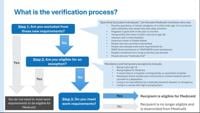
Slide taken from a Tuesday presentation from the Nevada Health Authority and Nevada Medicaid.
Back in April, the NVHA met with the Nevada Legislature to talk about the implications, but there were still some unknowns while waiting for final regulations from the federal government.
New federal guidance was released in June, giving the Nevada Health Authority a better idea of what those changes will look like.
"It was about 300 pages, and our team has spent a ton of time digging into the complexity of this and there are two key components," Jensen said.
In April, 2 News Nevada shared that there were only four different things the state had control in when it came to the new regulations.
One of those was that the state can decide if it wants to include short term hardship exemptions.
The NVHA will be including these exemptions which include, natural disasters, living in a high unemployment county, traveling far due to care, or having a recent hospital stay.
Meaning if you fell into one of these areas, you would be exempt from the work requirements.
The other item that wasn’t clear months ago, is which users would fall under the ‘medically frail’ exclusion.
Those now include blindness, a physical, intellectual, or developmental disability, a substance abuse disorder, a disabling mental health disorder or having a serious or complex medical condition that impacts their ability to work.

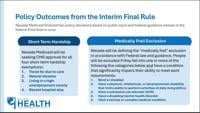
Slide taken from a Tuesday presentation from the Nevada Health Authority and Nevada Medicaid.
The other piece that goes into effect in January, is instead of reapplying for Medicaid once a year, it’ll now be twice a year.
"What I want folks to really hear is, we're doing everything we can to not have to ask for more information."

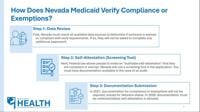
Slide taken from a Tuesday presentation from the Nevada Health Authority and Nevada Medicaid.
NVHA will use data in its system first to determine compliance before reaching out to you.
Documentation will be required in 2028, but you should keep documentation on you in case of a federal audit.
The next steps will include lots of communication and outreach.
The authority will send about 280,000 Nevadans reminders about the changes to Medicaid by September 1.
If you would like to view the entire Tuesday meeting, click here.
APRIL 2026:
Last year, President Donald Trump signed his One Big Beautiful Bill Act into law.
Following that, SNAP benefit requirement changes were the most imminent, but there is a lot more that Nevadans will want to keep tabs on.
On Tuesday, the Nevada Legislative Joint Interim Committee on Health and Human Services heard how the bill's impacts will continue to affect Nevada in the coming years.
New Medicaid work requirements and exemptions
The Nevada Health Authority, which was formed by Nevada Governor Joe Lombardo in the 2025 Nevada Legislative Session, was the first agency to give a presentation.
It was also the longest, given how much they are seeing from the federal level.
By January 2027, there will be some new eligibility changes, specifically work requirements for adults from 19-64 years old without children, or parents who have children older than 13 years old.
Those requirements say that those people must be working at least 80 hours a month or earn at least $580 a month.
People can fulfill this through working, job training, community service, school, self-employment, or seasonal work. They can also mix and match them.
This group is expected to contain about 147,000 Nevadans, but the NVHA says most people in the group are already working in some capacity.
There are a lot of exemptions. This new rule does not affect those on Medicare, people with disabilities, pregnant women, seniors, or parents with children 13-years-old or younger.
When determining who is exempt, the state will look at three different areas. Who you are, your health needs, and your situation.
759,295 people in Nevada are currently enrolled in Medicaid. 67 percent are working in Nevada.
Another new part of the process will be a 6-month eligibility redetermination.
Currently, members only have to renew once a year. The new law requires that to happen every six months.
The new requirements don't go into effect until January 1, 2027.
There is still a lot of uncertainty in the air as more federal guidance is set to be released in June of this year.
Another new requirement is new copays for Medicaid members and services.
Those don't go into effect until October 1, 2028.
How can the state get involved?
There are four areas in which Nevada Medicaid and the NVHA have flexibility.
The first are short-term hardship exceptions.
In the event of disasters, hospitalizations, distant travel for care, and high-unemployment counties, those people could be eligible for an exemption for a period of time.
The second is checking for compliance. This portion involves how far back the state should look when checking if someone meets work requirements.
Nevada recommends checking one month prior for new applicants, and for renewals, one month during the six-month period.
The NVHA says this will help reduce the burden and paperwork to prove compliance.
The third is when the state makes the transition to six-month renewals.
There are two options. The first is when the six-month cycle starts January 1, 2027, the state would move your renewal dates to January and July. However, this creates a large wave of renewals that all happen at once.
This is why the state prefers not to move members' renewal dates. This would mean your current renewal date will stay the same, and the next renewal will be six months from that date.
The NVHA says this makes it more predictable for Medicaid users and staff.
The last decision point is defining who is "medically frail" from work requirements.
Nevada Medicaid has a draft definition available now.
The state is still awaiting that additional guidance before verifying.
In the meantime, the Nevada Health Authority is looking to collect public comments, review feedback, publish final decisions, and host future workshops.
Another component is eligibility changes for lawful immigrants, which is forecasted to impact about 5,000 Nevadans.

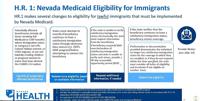
New Medicaid changes for lawful immigrants
Changes to Medicaid tax programs
Three changes impact two of Nevada's Medicaid Provider Tax programs. The private hospital tax program and the EMS tax program.
The first change is a moratorium on provider taxes, which means no new state Medicaid provider taxes, which will lower state revenue choices.
The second is a reduction in tax rates over the course of time, from 2027 to 2031, from 6 percent to 3.5 percent tax rates on patient revenues.
Each year lowers the tax rate by 0.5 percent. This will lower the revenue the state is allowed to get from provider taxes.
Lastly, a lower cap on state-directed payments.
In the current biennium, about $15 billion goes towards Medicaid. About 60 percent comes from the federal government, and the other 40 percent comes from state and local government.
The Nevada Health Authority gave estimates on how the funding changes will impact healthcare in the state.
For the Private Hospital Tax, the money supplants the state general fund for services for children's behavioral health.
Losses in tax revenue will affect the state Medicaid budget by about $25 million to $30 million in fiscal year 28/29. The NVHA is expected to collect about $88 million to $93 million for behavioral health care.
The State Premium tax impacts are expected to bring $66 million to $79 million less for the state general fund.
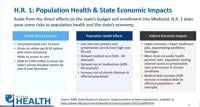
Uninsured rates are also a concern. In 2024, 367,300 Nevadans were uninsured, which makes up about 11 percent of the state's population.
The NVHA says uninsured rates could increase from 15 to 18 percent by 2028.
During the presentation, the organization said $600 million to $700 million could be lost in federal money for the state's private hospital system by the end of the next biennium.
Stacie Weeks, Director of NVHA, said that there are still a couple of billion dollars the system has to work with, and described the money as "the cherry on top, except they will lose the cherry."
When showing the state's health and economic impacts, there were a lot, including delayed medical care, increased risk of chronic illness, fewer jobs, increased medical debt, and more strain on public health partners.

After the lengthy presentation, the legislators had some questions.
"So moving forward with the Medicaid cuts, what is the plan for the homeless people?" Assemblymember Hanadi Nadeem (D), Las Vegas, asked.
"I think the way our medically frail definition is written, the majority of people experiencing homelessness due to conditions such as a substance abuse disorder or a mental health condition will automatically be exempt," responded Anne Jensen, Administrator, Nevada Medicaid.
Other committee members think more considerations need to be given.
"If they were on Medicaid and now they're going to be in a different situation, there is no proposal that I'm seeing right now that would fill that coverage gap," said Senator Fabian Donate (D), Las Vegas.
The Nevada Legislature can look at ways to pass state subsidies to help with coverage gaps.
More changes coming to SNAP
"As you are well aware, HR 1 has reshaped a little bit how we administer the SNAP program," said Kelly Cantrelle, Deputy Administrator, Nevada Division of Social Services, during the presentation of the Supplemental Nutrition Assistance Program (SNAP).
SNAP work requirement updates take effect this Friday. In order to keep your benefits, some adults from 18 to 64-years-old without dependents may need to meet the 20 hours a week work requirement.
You should have received a letter from the Division of Social Services if you'll be impacted.
Right now, about 27,000 Nevadans could lose their benefits.
Another component that was brought up during the meeting is the economic impacts.
The state receives about $89 million from the federal government for SNAP benefits. If those 27,000 are not eligible, the state loses about $5 million. The Division of Social Services says it has an economic impact of about $8 million, given the money for grocery stores and the impacts on local ranchers and farmers.
Currently, administrative costs for SNAP are split 50/50 between the state and federal government.
On October 1, this year that will change to 75/25 split.
"It takes about 100 million dollars to run the SNAP program every year," Cantrelle said. "So, the impact of this is 25 million dollars every year to the general fund, to the state's budget. It went from $50 million to $75 million."
Another change is that the state can't afford to make many errors when it comes to enrolling people for SNAP.
The benefits are 100 percent federally funded, but could change depending on the state's payment error rate.
If the state keeps it under six percent, it doesn't have to owe any money. If it's over six percent, the state could owe about $50 million. That could also increase if the rate ends up being higher.
There was a lot more covered in the meeting. If you would like to watch the whole meeting, click here.