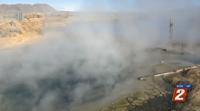
Sitting on the outskirts of the Black Rock Desert is a quiet, relaxing piece of private property known as Camp David, home of the Great Boiling Spring.
"These are from tectonic plate movement, where they get the heat instead of from volcanic action,” says David Jamieson, owner of Camp David.
These hot springs have been ground-zero to groundbreaking scientific research for the past two decades.
“They've found several different microbes and things that can live in this boiling water and there was an article about NASA giving them a grant to study and how these things can exist here,” says Jamieson.
Soon, a new monitoring system in the hot springs will help researchers have an even better understanding of how microorganisms adapt to this boiling water. The system will run off of solar, wind and generator power, all centrally located at the Camp David site. The energy will then be stored using a Czech battery manufacturer's latest lithium ion technology.
“It shrinks the module size, it increases the safety and lowers the manufacturing cost,” says Jan Prochazka, Director of HE3DA.
The international battery manufacturer called HE3DA is teaming up with UNLV to advance microbiological research in these rural Nevada hot springs. In order to monitor the hot springs successfully, it takes a reliable power supply in Gerlach’s extreme winter and summer weather conditions.
“The life expectancy here in these conditions would be 10 to 20 years,” says Prochazka.
That's more than triple the life-span of the previous batteries. HE3DA’s battery array replaces a lead-acid battery pack that couldn't meet the weather demands of the area. This kind of technological advancement at Camp David is what Jamieson says is needed to continue successful studies at the Great Boiling Spring.
“I'm all in favor of anything that can advance science,” says Jamieson.