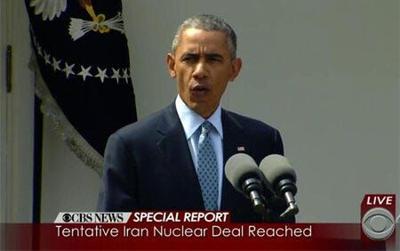
President Obama says the U.S. has reached a "historic" agreement with Iran and if implemented, will prevent the country from producing nuclear weapons.
He made the announcement on Thursday.
Obama spoke shortly after negotiators in Switzerland announced an understanding outlining limits on Iran's nuclear program. He says that if the framework leads to a final deal, it will make the U.S. and the world safer.
Obama has invested significant political capital in the nuclear negotiations. The talks have strained the U.S. relationship with Israel and deepened tensions with Congress.
One of Obama's toughest challenges will be convincing lawmakers to hold off on legislation that would authorize new sanctions on Iran. The president has warned that the legislation could upend the delicate diplomacy.
“First, Iran will not be able to pursue a bomb using plutonium because it will not develop weapons-grade plutonium.”
"Second, this deal shuts down Iran's path to a bomb using enriched uranium."
"Third, this deal provides the best possible defense against Iran's ability to pursue a nuclear weapon covertly."
Earlier, Secretary of State John Kerry tweeted there was a deal "to resolve major issues on nuclear program. Back to work soon on a final deal."
"Today we have taken a decisive step. We have reached solutions on key parameters of a joint comprehensive plan of action," European Union foreign policy chief Federica Mogherini said Thursday. "The political determination, the good will and the hard work of all partners made it possible and let us thank all delegations for their tireless dedication. This is a crucial decision laying the agreed basis for the final text of the joint comprehensive plan of action."
Mogherini said said the parties will now work on drafting the text of the comprehensive plan, with a goal completing the work by June 30. The working title is the Joint Comprehensive Plan of Action or the JCPOA.
Mogherini said that Iran will retain one enrichment facility at Natanz, and the Fordow nuclear complex would be converted to a nuclear physics, technology and research center that will no longer enrich uranium for at least 15 years. The E.U. and U.S. will release all nuclear-related sanctions only once the International Atomic Energy Agency (IAEA) verifies that Iran has complied with the agreement.
Iran will reduce approximately two-thirds of its of its installed centrifuges, a reduction from about 19,000 installed today to 6,104. Only 5,060 of them will enrich uranium for 10 years. All excess centrifuges and enrichment infrastructure will be placed in IAEA monitored storage. Iran has also agreed to not build any new facilities for the purpose of enriching uranium for 15 years.
It will redesign and rebuild a heavy water research reactor in Arak based on a design approved by the P5+1 negotiators. It will not produce weapons grade plutonium,
IAEA inspectors are supposed to have regular access to all of Iran's nuclear enrichment facilities
(The Associated Press and CBS News also contributed to this report.)