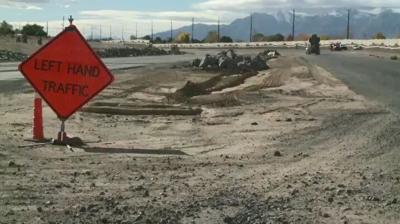
Roads that are deteriorated, congested and lacking safety features are costing each Nevada driver a big chunk of change, and today a national organization came to town to prove it.
The report, "Nevada Transportation by the Numbers," says the road ahead is dark for the state. This eye-opening expose comes from "TRIP," a nonprofit transportation research group based in Washington, DC. They rated all areas in the country, and say the Reno-Sparks-Carson City area is not in the good category. Rather, we're needing some help. TRIP’s Director of Research and Policy, Rocky Moretti told us, "In terms of pavement conditions, the region is at the middle of the pack of all urban areas."
Another study bears that out. Data from the Federal Highway Administration also puts Nevada in the middle. They say we have the 29th best roads in the country. Here's how their data breaks down: 14.1% of our roads are in "poor" condition. 13.1% of our bridges are deficient. Extra vehicle costs for road damage are $233 a year per motorist on average.
The TRIP group says when you add congestion with lost time and fuel, and crashes from deficient roads…our cost multiplies. Moretti told us, "The cost to the regional driver here in this area is $1,192 annually."
At the same time, there's been a 43% increase in vehicle miles traveled in Nevada from 2000 to 2014, and our population and road usage continues to increase. The money is not keeping up. Local transportation and economic leaders had much to say about the report's findings, and possible solutions. Carson Valley Chamber of Commerce board president Bobbi Thompson has a chart that shows just how many roads in Carson Valley need some help right now. As she showed us, "The red means our roads are failing. The yellow means our roads are close to failing. Those are the roads where you're getting your car out of alignment. Those are the roads where you're hitting those potholes. Waterloo Road is definitely in this kind of shape and is in very much need of fixing, and that’s heavily traveled."
Thompson says the worsening roads affect Carson Valley's economy, even tourism. "They visit less. If you come and look at a community and you travel and the roads are bad, you don't want to go back there. You want to go where the roads are safe to travel on."
Northern Nevada last OK'd a transportation sales tax measure in 2008 with the RTC gasoline tax. The federal gas tax hasn't been raised in 24 years. The feds and the state are not coming through. Thompson told us, "It's not enough, and this is dealing with inflation. We know the products to fix our roads keep going up."
Wherever the money comes from, its money well spent. The Federal Highway Administration says each dollar spent on road, highway and bridge improvements gives back $5.20 from fewer car maintenance bills, reduced delays, lower fuel consumption, and fewer road and bridge maintenance costs. Thompson says safe and efficient roads are not a luxury, and have passed the point to where they are a dire necessity. As she put it, "I want to keep my car in good shape...I don't want to hit those potholes. I also know that it impacts businesses when they select where they want to come. It impacts your home value."
This November, voters in all Nevada counties except Washoe County will consider indexing fuel taxes to inflation. If passed, the counties that enact that measure will receive more transportation funding for their local roads.