A federal judge has dismissed a challenge to bar former President Trump from appearing on the Nevada ballot.
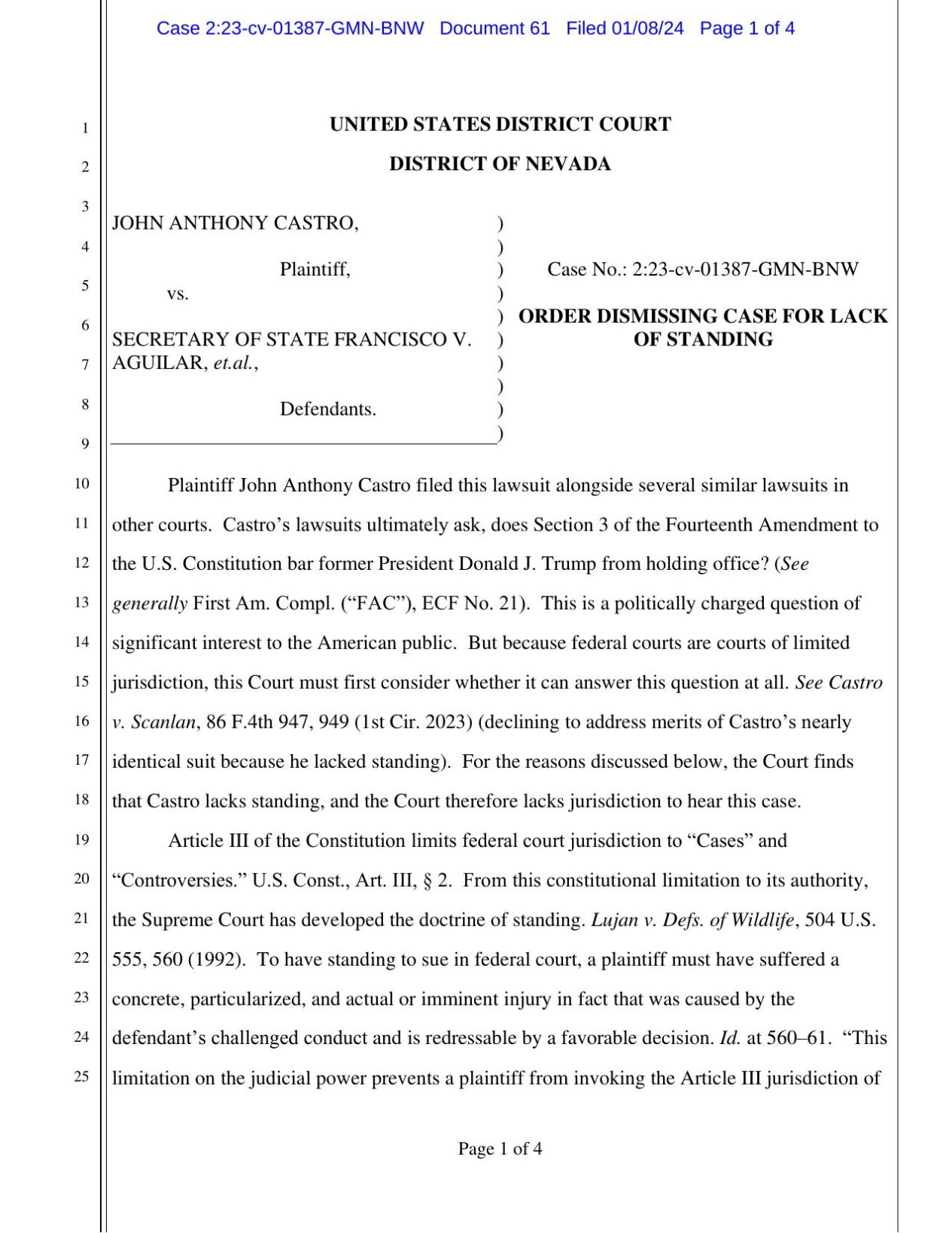
Presidential candidate John Anthony Castro filed the lawsuit, along with several similar lawsuits in other states, claiming that Trump does not qualify to run for president under Section 3 of the Fourteenth Amendment.
In its ruling, the District Court said "Because Castro does not have standing to challenge Trump’s eligibility to run for president, the Court does not have jurisdiction to rule on the merits of this case."
The district court also cited dismissals for lack of standing in several other federal courts where Castro had filed similar suits.
"Today’s dismissal of another bogus, bad-faith, Crooked Joe Biden-engineered attempt to deprive Americans as a whole, and the voters of Nevada specifically, of their right to vote for the candidate of their choice is not only a victory for President Trump, but a victory for all Americans and the people of Nevada," said the Trump Campaign in response to the ruling.
You can read the ruling and the Trump Campaign's response to it in full below.

WHAT'S THE LEGAL ISSUE?
After the Civil War, the U.S. ratified the 14th Amendment to guarantee rights to former slaves and more. It also included a two-sentence clause called Section 3, designed to keep former Confederates from regaining government power after the war.
The measure reads:
“No person shall be a Senator or Representative in Congress, or elector of President and Vice-President, or hold any office, civil or military, under the United States, or under any State, who, having previously taken an oath, as a member of Congress, or as an officer of the United States, or as a member of any State legislature, or as an executive or judicial officer of any State, to support the Constitution of the United States, shall have engaged in insurrection or rebellion against the same, or given aid or comfort to the enemies thereof. But Congress may by a vote of two-thirds of each House, remove such disability.”
Congress did remove that disability from most Confederates in 1872, and the provision fell into disuse. But it was rediscovered after Jan. 6.
(The Associated Press contributed to this report.)