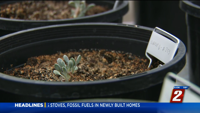



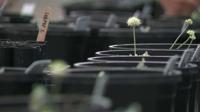

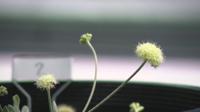
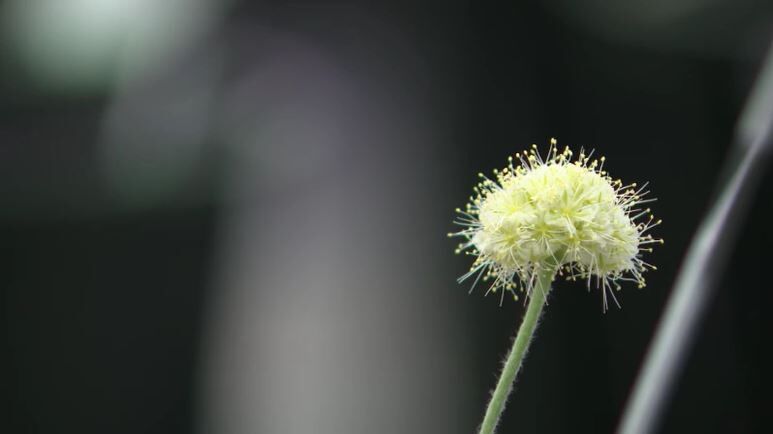
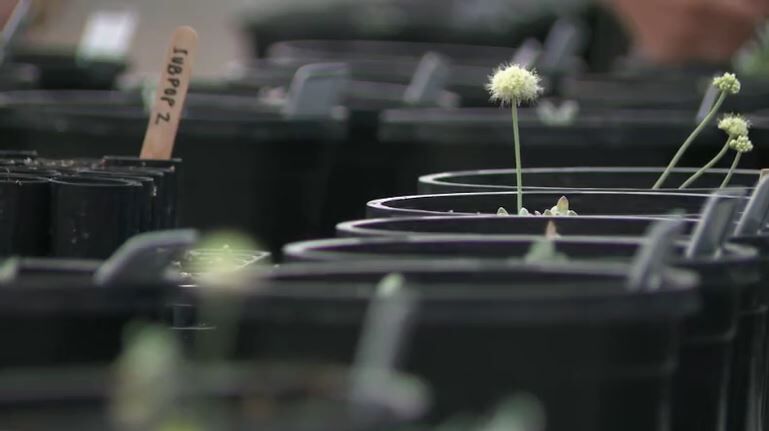
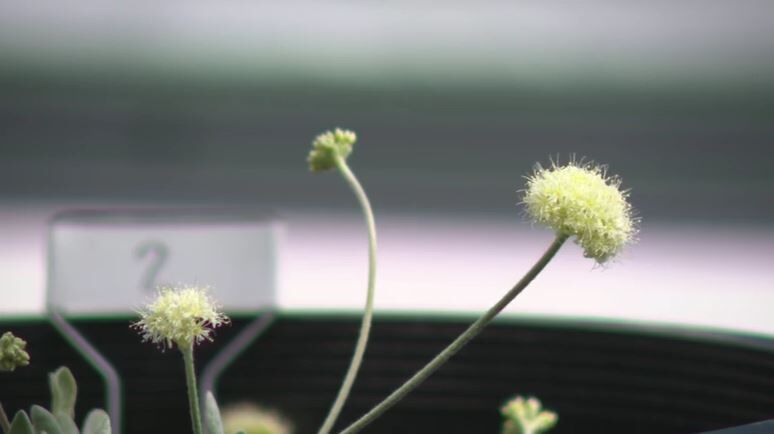
Three-hundred tiny, flowering Tiehm’s buckwheat plants are a far way from home, putting down roots at a greenhouse in Gardnerville.
Mining company Ioneer is propagating and studying the endangered species, and they held a grand opening for the greenhouse on Wednesday, calling it the “Tiehm’s Buckwheat Conservation Center.”
The company’s planned lithium mine in Esmeralda County overlaps with Tiehm’s buckwheat’s only known habitat – 10 acres of land in the Silver Peak Range.
CEO Bernard Rowe said at the greenhouse opening that the mine will not push the endangered plant into extinction. Though, he admitted that Ioneer’s relationship with the buckwheat hasn’t always been so accommodating.
“Our early applications involved moving some of the plants, and after consultation with (the U.S. Fish and Wildlife Service) in particular, we realized that that wasn’t the right path forward,” he told 2 News at the grand opening.
He said that Ioneer has redesigned its mine to avoid the plant species entirely.
The Center for Biological Diversity petitioned to protect Tiehm’s buckwheat in 2019, and in 2022 the plant was listed as an endangered species.
Ioneer was granted a $700 million conditional loan from the U.S. Department of Energy in January 2023, and one week later the Bureau of Land Management cited the company for trespassing on buckwheat habitat.
Rowe said at the time that no Tiehm’s buckwheat was affected by the trespass. He reiterated on Wednesday that Ioneer will not interfere with the plant’s habitat.
One of the company’s findings in growing the plant itself is that the buckwheat will survive in conditions other than those in the Silver Peak Range.
“The type of soil that we are using is very different from the one that you can find at the side,” said agricultural engineer Florencia Peredo. “It’s growing very good here, and I think that that’s a good thing that we discovered.”
Rowe said that Tiehm’s buckwheat grows only on the western edge of the planned mine, covering less than 10 percent of the lithium and boron deposit. He says that Ioneer is committed to avoiding that area entirely.
“We’re counting the plants regularly, several times per year, that are at our site to make sure that the populations are not diminishing,” he said.
Rowe hopes to break ground on the mine construction in early 2024, and begin production of lithium and boron by 2026.