

Thanks to an emergency use authorization by the FDA last week, we now have two vaccines for the coronavirus that are circulating across America. What's the difference between the two?
Well, as far as effectiveness, current data shows both the Pfizer and Moderna vaccines are 94-95 percent effective.
Both require two doses, with Pfizer’s second shot 21 days after the first, and Moderna's 28 days after.
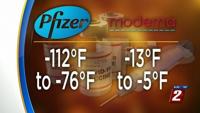
The big difference comes in how they are stored, with Pfizer’s vaccine needing ultra-cold storage at -112 to -76 degrees Fahrenheit.
Moderna's vaccine can be stored in a standard freezer at -13 to -5 degrees.
While they both use a technique utilizing mRNA, neither one changing the recipients DNA, they cannot be taken together or substituted.
Meaning if you get the first shot of Pfizer’s vaccine, you cannot get the second with Moderna's.
Both the Pfizer and Moderna vaccine have age restrictions. Pfizer is for those 16 and older, while Moderna is 18 and older. Officials say this makes getting that vaccine important for protecting those who can’t get it.
“None of these vaccines right now are available or authorized to be used on children or minors, therefore we need almost all willing adults to be vaccinated if we want to go on with our normal days and have our economy the way it was in 2018 and 2019," says James English, the Regional Operations Chief for Vaccine Distribution in Wahsoe County.
The two vaccines also have similar side effects, all of which should subside shortly after the inoculation.
“It's a short period of time that people are experiencing feeling tired and getting headache, slight fever, those types of things. But that just means that their body is revving up so they body can fight COVID-19 down the road,” said Washoe County Health Officer Kevin Dick.
There are also a few reports of allergic reactions to the vaccines, and although rare, all recipients of the vaccines are monitored on-site for about 15 minutes after receiving the vaccine.
The CDC recommends those who have had a severe allergic reaction to any ingredients in the vaccines to not get that specific one.
As of right now, when it becomes widely available next year, it looks like the public will not be able to choose which vaccine to get if they chose to receive it due to limited quantity.
“For the foreseeable future, I don't think people will have any opportunity to make a choice on which one they are going to get, it will be whichever is available at the time that they are getting their vaccination," said Mr. Dick.