


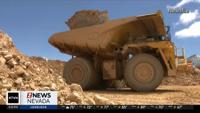


Nevada's critical mineral mining industry is set for significant economic growth, and a recently passed bill in the U.S. House could expedite it.
Congressman Mark Amodei's 'Mining Regulatory Clarity Act 2024' aims to undo a consequential court ruling restricting mining companies' use of federal lands. Amodei's bill passed in the U.S. House with a 216-195 vote in early May.
2 News Investigate: Rhyolite Ridge (Part 1 - 3)
The bill aims to overturn a 2022 9th Circuit Court of Appeals decision that prohibits companies from conducting mining support operations on federal lands unless valuable mineral deposits are confirmed. The mining law pertains to public lands in districts that are in the 9th Circuit, which include Arizona, parts of California, Hawaii, Idaho, Montana, Nevada, Oregon, parts of Washington, and others.
The "Rosemont" decision blocked a proposed copper mine in Arizona. It overturned the government's previous interpretation of the 1872 Mining Law, which gives adjacent federal land the same rights as a valid mining claim.
"It puts the cart before the horse in a mining sense," said (R-NV) Congressman Mark Amodei, "What it said was, unless you prove your claims are viable before you do like a mine plan or something like that, you can't use any of the federal lands around that for ancillary uses like roads, offices, mill sites, the response of waste rock and stuff like that, which had always been done," said Amodei.
The Rosemont decision requires companies to demonstrate the presence of valuable minerals beneath the land before making a claim, which the government must validate.
"The Rosemont decision was seen as a side door or back door thing, and it caught a lot of people by surprise, but it struck a blow potentially at the heart of the mineral industry as we've known it in modern times," said Amodei.
The Nevada Mining Association applauds Congressman Amodei for the Mining Clarity Act, which would undo Rosemont, while upholding strict environmental regulations for mining in the U.S.
"It's not allowing miners any other rights or privileges they didn't have before. They still have to go through all of the permitting requirements. They have to follow the National Environmental Policy Act, also known as NEPA, which is a rigorous multi-year permitting process. Permitting exists at the federal and state levels; none of those responsibilities change with the Mining Clarity Act," said Nevada Mining Association President Amanda Hilton.
Hamilton contends that The Mining Clarity Act would provide assurances of the permitting and regulatory process for mining companies in Nevada.
"It would allow for the hundreds of millions or billions of dollars needed for expansion of mining properties in the state. Without that clarity, mining companies would have a lot of hesitancy in investing those funds," explained Hilton.
Environmental groups are pushing back. Center for Biological Diversity Great Basin Director Patrick Donnelly provided the following statement:
"This bill would create a free-for-all on public lands, with speculators able to file claims even when there are no valuable minerals present," said Donnelly. "Nevada is at the epicenter of a huge mining boom right now, and our public lands need strengthened protections. Instead this bill aims to unleash the mining industry, with devastating consequences for Nevada's wildlife and communities."
Senators Catherine Cortez Masto and Jacky Rosen agree with Amodei's legislation.
Senator Jacky Rosen provided the following response:
"Nevada is one of the few places in the United States with an abundance of critical minerals and a robust hard rock mining industry," said Senator Rosen. "The responsible mining of these minerals supports thousands of jobs and will help strengthen our domestic manufacturing and clean energy supply chains, lowering costs for hardworking Nevadans."
