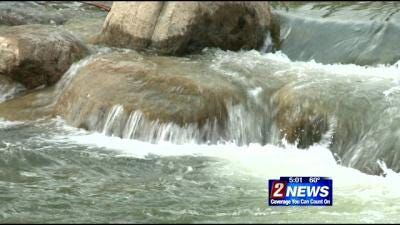

Reno Fire Crews are seeing an increased number of calls for water rescues on the Truckee River, and this time of year, the water temperature makes it even more dangerous.
The RFD water rescue team has so far responded to about a dozen rescues in 2016. Most of the rescues early in the year are related to ice, but just in the past week, crews have responded to four calls on the Truckee River.
One of those involved four people who fell off of the devices they were using to float down the river. Crews responded to the area of the river near W 4th Street and McCarran Blvd. in Reno around 1:30 p.m. Sunday. All four made it to shore but, despite the spring-time temperatures in the air, they were treated for hypothermia.
Battalion Chief Dirk Minor says you lose body heat 25 times faster in water than air at the same temperature, "the river is really cold and people can quickly find themselves limited on their ability to do any kind of self rescue," says Minor.
Minor says hypothermia can start in just three to seven minutes.
"Hypothermia starts once the core temperature is below 92 to 94 degrees," says Dr. Brian Barnes, attending physician at Saint Mary's Emergency Room, "you start to lose certain sensations and inhibitions, become weaker... you may start to get light-headed, feeling weak, dizzy and shivering ... then you'll just become more weak and weak, until you potentially may pass out."
Dr. Barnes says alcohol makes the problem worse, because it inhibits the system that controls internal body temperature.
Rescue crews wear special gear when getting into the water, "They have not only a dry suit which helps with some of the thermal protection, but there's also an insulation layer that we put on underneath as well for these kinds of temperatures," says Minor.
Minor says we won't see warmer water temperatures until June to early July and later in the summer.