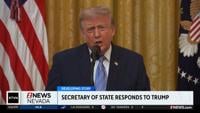

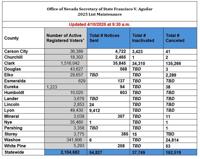
The Nevada Secretary of State’s Office is reporting on voter roll cleanup efforts following the 2024 General Election, including the cancellation of more than 160,000 voter registrations, and the inactivation of more than 37,000 voters.
“The Secretary of State’s Office takes the transparency, security and accessibility of our elections very seriously, and is focused on supporting the counties’ efforts to clean the voter rolls,” said Secretary of State Francisco Aguilar. “The implementation of our statewide voter registration and elections management system will continue strengthening our ability to streamline list maintenance processes and provide data to the public.”
In accordance with state and federal law, county election officials across Nevada’s 17 counties are sending out notices so that voters can confirm or update their address, or inform the county that they have moved or would like to have their voter registration canceled.
In total, counties have canceled 162,519 voters and inactivated 37,749 voters, as of April 10th, 2025.

Examples of Notices Sent to Voters:
* “Undeliverable” Mail Ballot: When a county election official sends an active registered voter a mail ballot, and it gets returned as “undeliverable,” the county will move forward with sending a notice to that address to confirm the voter no longer lives there. If the county election office does not receive any contact from the voter, they can then inactivate them.
- An example of a notice a county may send out due to an “undeliverable” mail ballot can be viewed here.
* Change of Address: Notices may be sent to voters’ addresses that are flagged as part of the National Change of Address program, used by the United States Postal Service to update mailing addresses.
* Voter Inactivity: Notices may be sent to voters who have not voted or contacted their county election official for a specified period of time, in compliance with the National Voter Registration Act.
How can voters help?
The Secretary of State’s Office encourages voters to help keep the voter rolls clean by checking their voter registration information on VOTE.NV.gov. You can update your address, political party and other information to ensure your information is up to date. The Office also encourages voters to provide their phone number and/or email address to receive critical information from their local election officials as the 2026 election cycle approaches.
What does it mean to be an ‘active,’ ‘inactive,’ or ‘canceled’ voter?
* An active registered voter includes any voter who is legally eligible to vote and has registered with their county election official.
All active registered voters in Nevada receive mail-in ballots for each election unless they opt out of receiving a mail in ballot.
* An inactive registered voter includes any voter whose address is identified as potentially no longer valid. A county will send a notice to the voter’s address on record, and if they don’t receive contact from the voter, they will move them to inactive status.
Inactive registered voters do not receive mail-in ballots for any election, but they remain on the voter rolls for a prescribed amount of time, per the NVRA, and are still eligible to vote.
If voters do not respond and do not vote for two federal general elections in a row, their registrations may be canceled
* A canceled voter is a voter who has been removed from the voter rolls. This can occur when a voter is identified as deceased, if a voter cancels their own registration, and through the NVRA and notice processes done by the counties to routinely update the voter rolls.
If your voter registration was canceled due to a felony conviction, your right to vote is immediately restored upon your release from prison. Learn more here.
Your voter registration can be reviewed, updated or canceled at any time on VOTE.NV.gov. Should there be any questions, please do not hesitate to contact the Elections division at 775-687-8683 or email us at nvelect@sos.nv.gov.
Learn more about list maintenance efforts and guidance here.
(Secretary of State's Office contributed to this report.)