

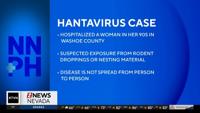


Northern Nevada Public Health is reporting a case of Hantavirus in Washoe County.
The case involves a woman in her 90s who was hospitalized, according to a release from NNPH.
The suspected exposure was from inhalation or direct contact with rodent droppings, urine, or nesting material that was stirred up due to household carpentry work in the weeks before the patient's symptoms developed.
The investigation is ongoing.
This is the first case of hantavirus in Washoe County since August of 2023.
The disease is a respiratory infection that mainly occurs from breathing in particles of infected rodent droppings, urine, or saliva, and can be fatal.
The CDC says 38 percent of people who develop respiratory symptoms may die from the disease.
Early symptoms can include fatigue, fever, muscle aches, and vomiting. You can learn more about symptoms at this link.
NNPH has provided tips to minimize the risk of contracting the illness.
- Do not sweep or vacuum the area with urine, droppings, or nesting material.
- A solution of 1 part bleach to 9 parts water should be used when cleaning urine and/or droppings (1.5 cups bleach to 1 gallon of water).
- Spray the solution on areas with rodent droppings and leave for 5 minutes before wiping the area with disposable paper towels or cloth. Dispose of the waste in a sealed plastic bag.
- Wear gloves (i.e., latex, vinyl, rubber) and a face mask to avoid touching or breathing in viral particles.
- Identify areas where mice are and plug openings and set traps; a deer mouse can fit through an opening the size of a nickel. Food should be stored in rodent-proof containers.
Hantavirus is only spread by rodents and not from person-to-person. Rodents such as the white-footed deer mouse found in Washoe County spread it to people.