
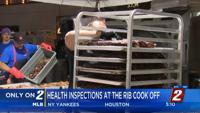


With huge events like the Rib Cook-Off there has to be guidelines for food, how it's prepared and how it's stored when the night is over.
“You have guidelines of cooking, you have to have it with how many people come through events, it’s a health issue, you have to be very aware of your temperatures throughout the entire day, it doesn’t matter how busy you get, you have to hit your numbers to make it safe for everybody,” said Jim Lupinetti, a Pit Master for Butch’s BBQ.
If the food is over cooked it's not going to taste the best, but if the food is undercooked then it could make someone very sick, that's why health code enforcement is so important.
Each type of meat has a different number of temperatures to be considered properly cooked.
“It’s always different, so if it’s chicken it’s 160 and up, if it gets too much then you dry it out so it’s the sweet spot that you have to keep it,” Lupinetti explained.
So, when there are ribs left over that haven't quite hit a customer's plate or even the grill yet where does it all go?
“As it’s hot to serve for people in general, you have to get it below that threshold very very quickly and the quicker you get to that number the more efficient the safer that it is for everybody,” Lupinetti said.
When ribs are ready to be served, they'll be 190 degrees or higher, then you'll want to say away from the danger zone, which means cooling down the meat below 70 to 80 degrees as soon as possible.
Then they continue to lower the temperature in order to safely freeze the food items for the night.
“We try and let them cool even a little more than that because if you put a bunch of hot products in a cooler it makes it really hot inside your cooler or wherever you're holding the space for your food, so you have to be very aware of that as well,” Lupinetti said.
When the health inspector comes through, he's making sure the rib booths aren't missing, anything at all.
“A lot of teams like to hot hold through the night we don’t do that, we cook fresh every single day, so we don’t have to worry about that," Lupinetti said. "Some people cook through the night, so the temperature has to be appropriate for what it has to be and what they’re doing.”
If the Washoe County Health District inspectors do find something wrong in one of the booths, then they throw the food out completely.
“If the health department does find say, ribs, pork or brisket or something that isn’t safe for the public to actually use they will pour bleach on it and then that ensures that it gets thrown out because it’s a lot of money and some people may try and reuse it so they do the bleach to ensure that it doesn’t go to any of the customers,” Lupinetti told us.
As we followed Butch's BBQ throughout the night, told us they do pass inspections every night and they say they take health and safety to another level.
“We don’t like clutter we don’t like things that are dirty and every surface gets wiped down with bleach water, we just sanitize everything, every night, every morning like we just go through it time and time again and make sure everything’s swept up,” Lupinetti said.
It also helps them to have multiple people on their team double checking each other's work to make sure the job gets done thoroughly.
“We want to be putting out the best product and we also want to be clean and we’re just very organized and clean with our product and that’s how we cook as well,” Lupinetti said.
The Washoe County Health District inspectors again check everything, especially the meat at the end of the night.
“They check your temperatures of if it’s cold, say if I cool down these ribs we have to put our times when we put it in," Lupinetti explained. "The date so that they know the threshold of the time of when it actually got into our coolers, what temperature it went in the coolers–say if I put it in at 80 degrees they may come 2 or 3 hours later and see what temperature that is and that’s also how they say if that’s good or not and things of that nature.”
Butch's BBQ also told us it's helpful for them to have people who double check their work on their team so they can ensure no speck gets left behind.