




The City of South Lake Tahoe has adopted an ordinance to amend its vacation home rental (VHR) regulations and a resolution to provide an initial application period open only to prior VHR and Qualified VHR (QVHR) permittees.
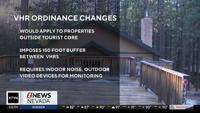
The proposed ordinance includes a 150-foot buffer between single-family VHR properties outside of the tourist core area. This is meant to avoid negative impacts on neighborhoods caused by VHR clustering.
The ordinance will take effect on July 17, according to a release from South Lake Tahoe Assistant City Manager Hilary Roverud.
The city will not issue permits before July 17, but they will open an initial 60-day VHR permit application period on June 23.
The initial application period will only be for applicants in good standing whose previous VHR permits at the same properties expired in 2021 and were not renewed at that time because of Measure T, and previous QVHR permittees in good standing whose permits became void in April 2025 because of the court’s ruling in the Measure T lawsuit.
After the 60 days, everyone else can file applications.
VHR applications will only be accepted through the online portal that will be active at 9 a.m. on June 23 and accessible through the city’s website.
Applications will be processed in the order in which they are completed, so people are encouraged to submit complete and accurate applications and to respond quickly to city communications about their applications.
The City Council has also directed that a report and discussion item be brought back for review of the VHR ordinance implementation efforts and code enforcement issues at their September 9 regular meeting.
---
ORIGINAL ARTICLE (JUNE 4):
The South Lake Tahoe City Council has voted to hold a first reading of an ordinance making significant amendments to the Vacation Home Rental (VHR) Ordinance, aimed at enhancing the regulation and management of vacation home rentals within the city.
A second reading and adoption of the ordinance is on the City Council agenda for the next meeting on June 17.
The draft ordinance introduces stricter regulations to address community concerns with VHRs operating in residential neighborhoods. These changes are designed to ensure that vacation home rentals operate in a manner that is respectful of the local community and environment.
The City says key amendments to the VHR Ordinance, that apply only to VHRs outside the Tourist Core, include:
* Imposes a 150-foot buffer between VHR properties instead of the previous cap of 1400 VHRs
* Prohibits VHRs in multifamily housing containing more than one unit, but allows VHRs in attached condominiums if they held a permit as of September 1, 2016, with condominiums exempt from the 150-foot buffer
* Requires local property managers that are available to respond to complaints and violations at all hours and every day of the week
* Requires the property manager to conduct in-person or virtual check in to verify identity and obtain renter signature on a good neighbor contract containing VHR rules
* Limits VHR occupancy to two per bedroom with up to five children (aged 13 and under) not counting toward the limit
* Requires indoor noise and outdoor video monitoring devices to allow property managers to detect nuisances before neighbor disturbance and to prevent violations
* Requires defensible space inspection prior to VHR permit issuance
* Requires compliance with conditions of operation at all times, even when owners, family or friends are using the property.
The ordinance amendments also include the ability for the City Council to establish a preference for prior VHR and Qualified VHR permit holders who were in good standing and not renewed because of Measure T restrictions.
If the City Council votes to adopt the ordinance on June 17, it will become effective on July 17. The City Council has also directed for the ordinance to be brought back to them for review in September.
(City of South Lake Tahoe)